Business Fundamentals
Why Quitting Your Job to Start a Business Is Bad Advice
Author: Trevor Hunter
Published: October 30, 2025
The advice to quit your job and go all-in sounds bold. It sounds decisive. It sounds like commitment. In reality, it’s one of the fastest ways to kill a new business before it ever has a chance to work.
Most people giving that advice have never operated under real financial pressure. They’ve never had to decide whether the next customer pays the rent or gets reinvested into the business. That distinction matters more than people realize.
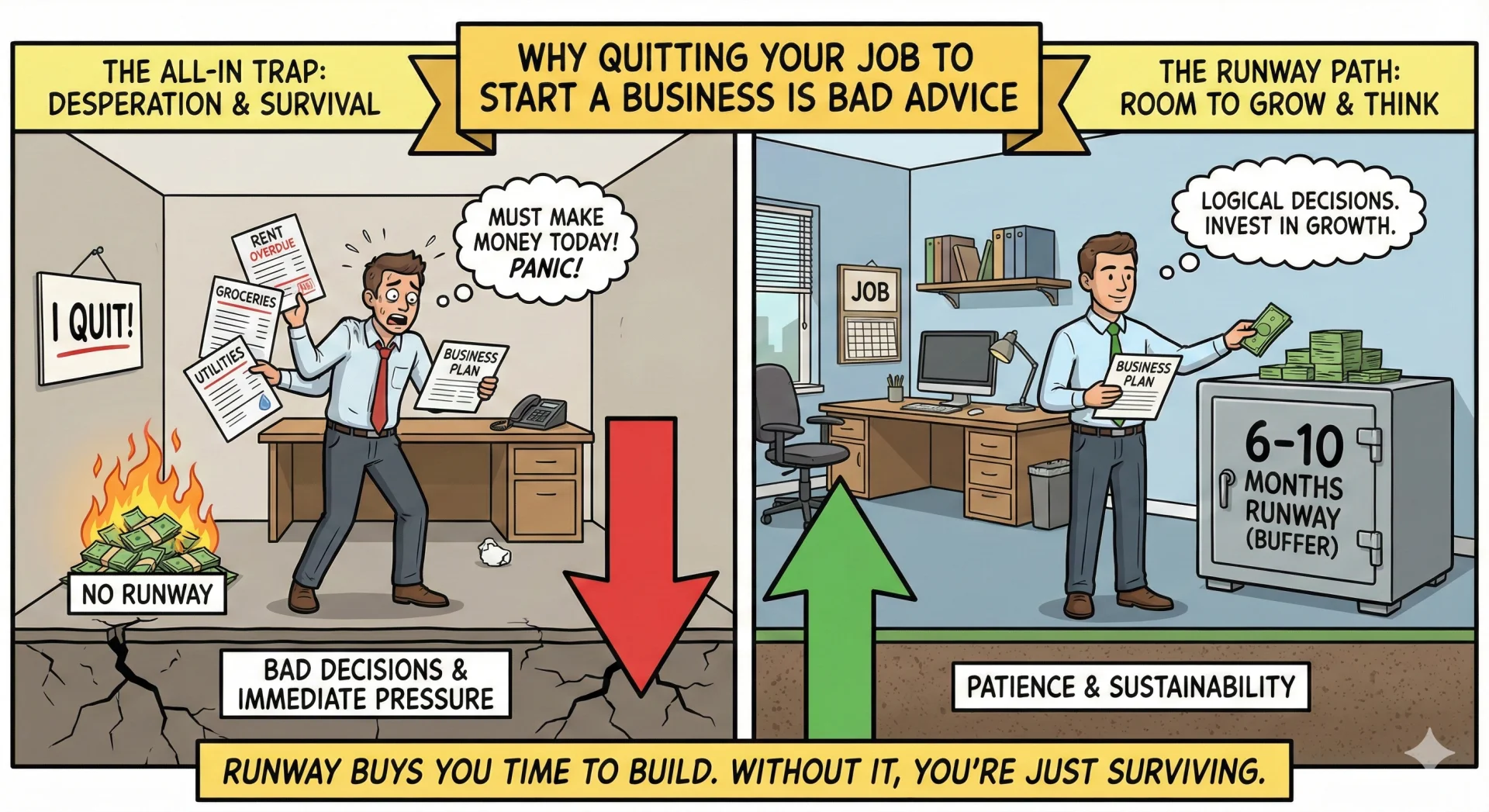
When you quit your job without runway, your business never gets ahead. It can’t. The first customer’s money doesn’t go toward growth, systems, tools, or stability. It goes toward groceries, rent, utilities, insurance, and credit cards. The business becomes a middleman between the customer and your personal bills.
That creates desperation immediately. Every lead matters too much. Every job feels like life or death. You underprice because you need cash now. You say yes to bad customers. You rush work. You skip planning. You make decisions emotionally instead of logically because the pressure is constant.
That pressure doesn’t make you sharper. It makes you sloppy.
The smarter approach is boring, and that’s why people ignore it. Figure out your monthly personal expenses. Multiply that number by six to ten months. Save that amount before you make the jump.
If your life costs $3,200 a month, that means $19,000 to $32,000 in runway. That runway isn’t there to make you comfortable. It’s there to protect the business from being drained the moment money comes in.
Runway changes how you operate. When the business earns its first dollars, that money can stay in the business. It can be used to improve operations, buy better tools, fix mistakes, or survive slow weeks without panic.
Without runway, the business is never allowed to compound. Every dollar gets siphoned off before it has a chance to do any real work.
There’s also a psychological shift that happens when you’re not desperate. You can walk away from bad customers. You can say no to work that doesn’t make sense. You can price properly instead of racing to the bottom. You can slow down long enough to build something sustainable.
People love to romanticize pressure. They say things like pressure creates diamonds or that fear will force you to succeed. That’s nonsense. Pressure creates short-term decisions that feel productive and long-term damage that’s hard to undo.
Most failed businesses didn’t fail because the idea was bad. They failed because the owner was forced to make survival decisions from day one. They never got a chance to think clearly.
Another problem with quitting too early is that it removes optionality. When you still have a job, the business can grow at its own pace. You can test pricing. You can experiment with marketing. You can make mistakes without them costing you your ability to pay bills.
Once the job is gone, every mistake hurts more than it should. That stress compounds fast, and it’s one of the main reasons people burn out and quit entirely.
Runway doesn’t guarantee success. Plenty of businesses fail even with money in the bank. But lack of runway almost guarantees failure because it forces the business to serve the owner’s immediate needs instead of the long-term plan.
There’s nothing brave about jumping without a parachute. It’s not commitment. It’s impatience.
If you want to build a real business, don’t ask how fast you can quit your job. Ask how prepared you are to let the business keep the money it earns.
Pressure doesn’t build good businesses. It builds bad habits.
Runway doesn’t make success inevitable, but it gives the business a fighting chance. And that alone puts you ahead of most people taking bad advice from the internet.