Websites
Why Business Coaches Can't Save a Bad Website
Author: Trevor Hunter
Published: October 11, 2025
The internet is full of business coaches telling people how to grow. More mindset. More confidence. More pricing strategy. More scripts. More belief. None of that fixes a bad website.
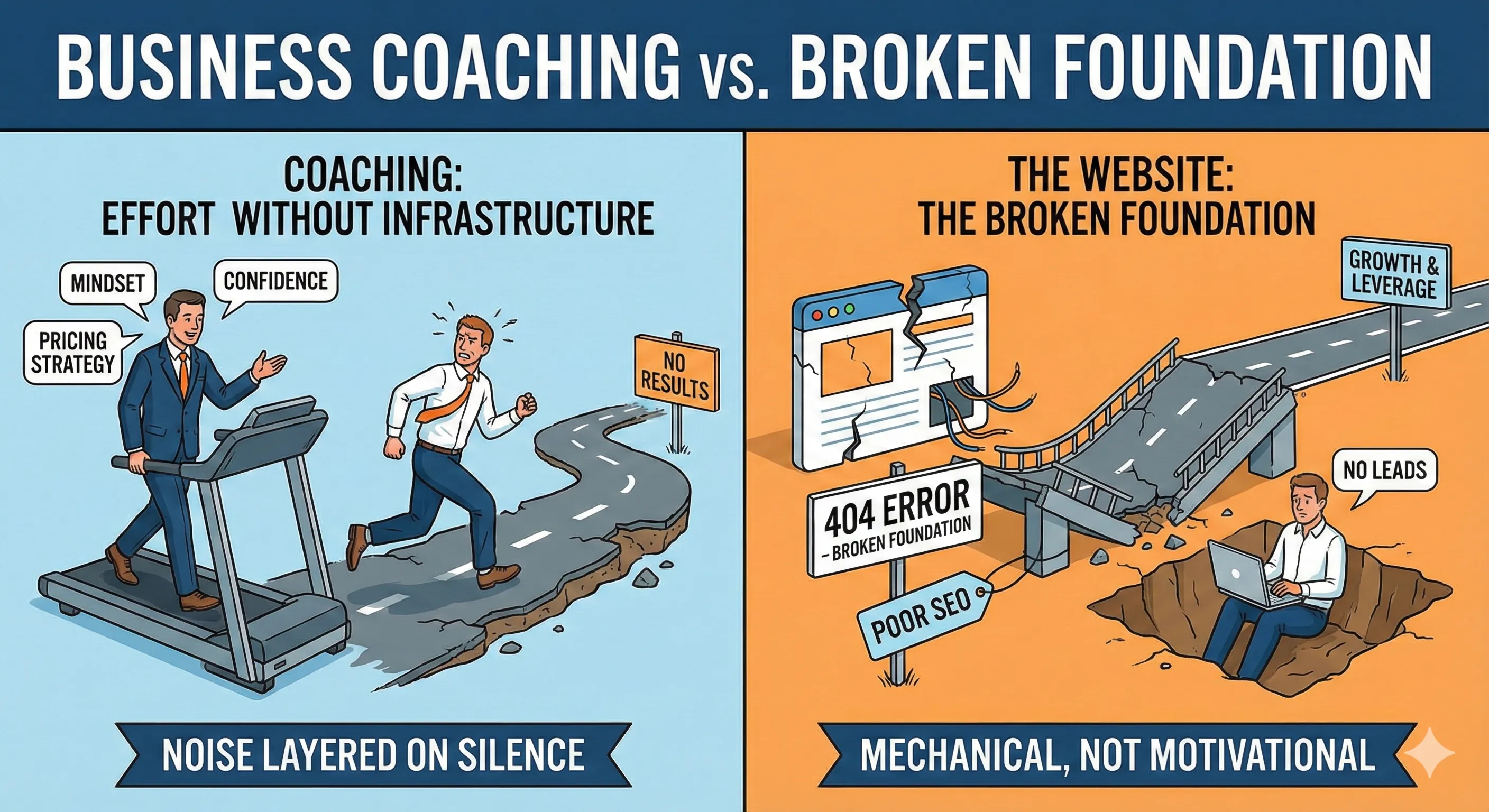 why-business-coaches-cant-save-a-bad-website.webp" alt="Why Business Coaches Can't Save a Bad Website" style="width: 100%; height: auto; margin: 30px 0; border-radius: 8px;">
This is where a lot of businesses get stuck. They keep investing in advice while ignoring infrastructure. They buy courses, join groups, and watch endless videos, all while sending potential customers to a website that can't rank, can't convert, and can't support growth.
No amount of coaching compensates for a broken foundation.
Most coaches don't talk about websites because they don't understand them. They talk about effort, discipline, and vision because those are easy to generalize. Infrastructure is not. It's specific. It's technical. It's unforgiving.
A bad website quietly undermines everything else a business does. Ads get sent to pages that don't convert. Referrals look the company up and lose confidence. Search demand goes to competitors who show up instead. The owner feels like they're doing everything right and still falling behind.
That gap breeds frustration.
Coaches often respond by telling owners to push harder. Raise prices. Post more content. Believe more strongly. The business owner internalizes the failure and assumes the problem is personal. It usually isn't.
It's structural.
Websites are not motivational tools. They're mechanical ones. They either work or they don't. They either show up or they don't. They either answer questions clearly or they don't.
Coaches can help with decision-making and accountability. They cannot rewrite how Google evaluates a site. They cannot fix load time, structure, or intent mismatch with mindset alone.
Another issue is that many coaching programs assume a functional marketing foundation. Their strategies rely on inbound interest, brand credibility, or consistent visibility. When those things aren't present, the advice falls flat.
That doesn't mean the advice is wrong. It means it's being applied to the wrong layer of the business.
You don't optimize pricing before you have demand. You don't refine messaging before people can find you. You don't scale before the system works.
Bad websites create false negatives. They make good businesses look weak. They make solid offers seem risky. They make competent operators feel invisible.
That's why so many owners cycle through coaches without seeing real change. They keep adjusting behavior while the bottleneck stays untouched.