Websites
Why Most Business Websites Never Rank (And It's Not SEO)
Author: Trevor Hunter
Published: September 22, 2025
When a business website doesn't rank, SEO usually gets blamed first. Owners assume keywords are wrong, content isn't long enough, or Google is ignoring them. In reality, SEO is rarely the core issue.
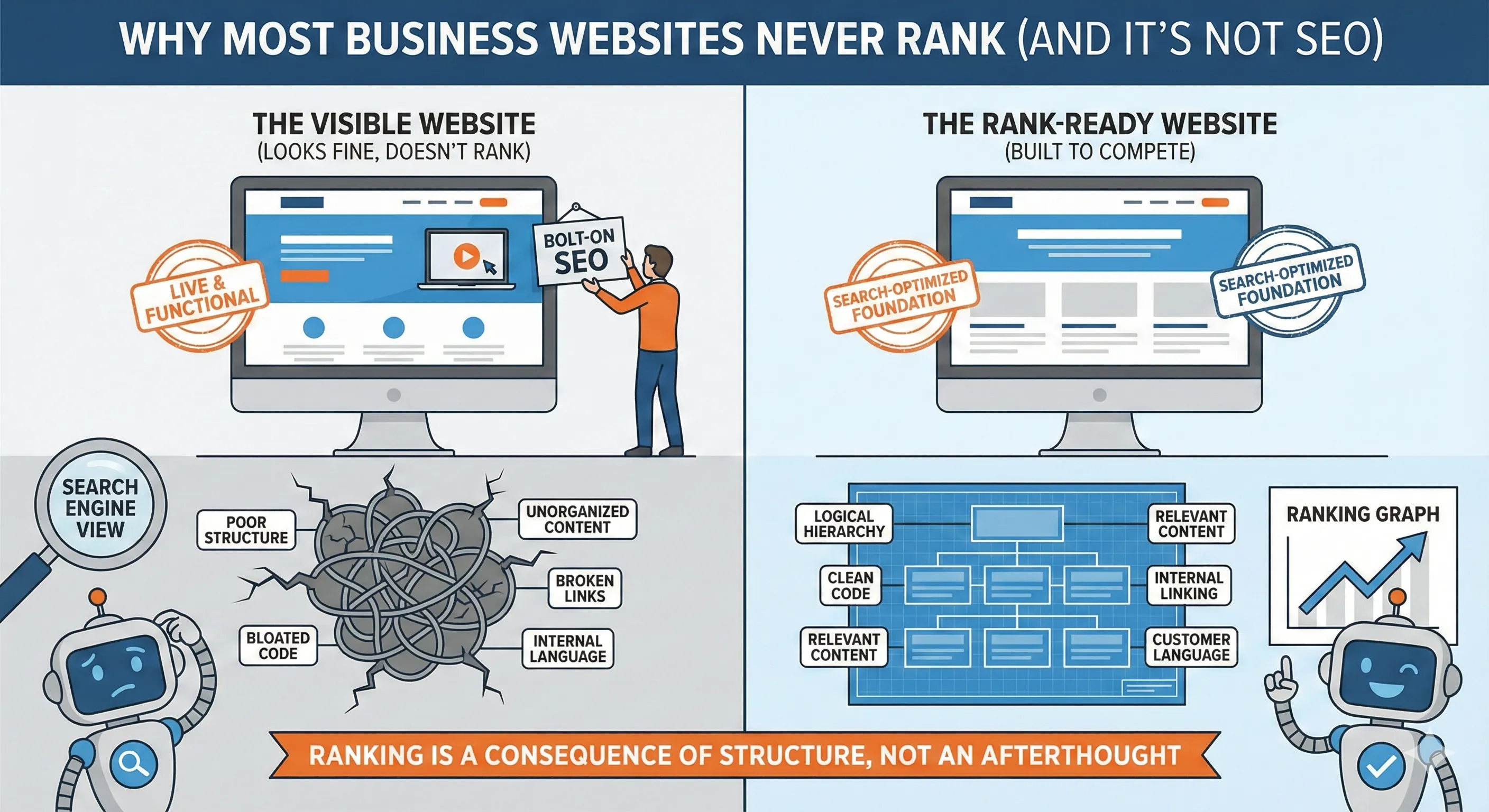
Most websites don't rank because they were never built to.
Search engines don’t evaluate websites based on effort or intention. They evaluate structure, consistency, and compliance. If those fundamentals aren’t in place, no amount of keyword tweaking changes the outcome.
A common mistake is treating SEO as something added after a website is finished. Businesses launch a site, then later try to “do SEO” to make it rank. That approach is backwards. Ranking is a consequence of how the site is built, not a feature that can be bolted on.
Websites that never rank usually share the same problems. Poor structure makes pages hard to crawl. Bloated frameworks slow everything down. Content exists, but it isn’t organized in a way that signals relevance. Internal linking is inconsistent or nonexistent.
None of these issues are obvious from the outside.
That’s why owners are often confused. The site looks fine. It functions. It loads. From their perspective, it should be working. But search engines see something very different.
Another factor is intent alignment. Many websites talk about the business instead of the service. They use internal language instead of customer language. They describe how the company feels instead of what problem it solves. That disconnect makes it difficult for search engines to match the site to real searches.
Content volume is often misunderstood as well. More pages don't automatically improve rankings. Pages that aren't intentional dilute relevance. They add noise instead of signal.