Websites
Why a Fast Website Still Doesn't Convert
Author: Trevor Hunter
Published: September 1, 2025
Speed matters. There's no arguing that.
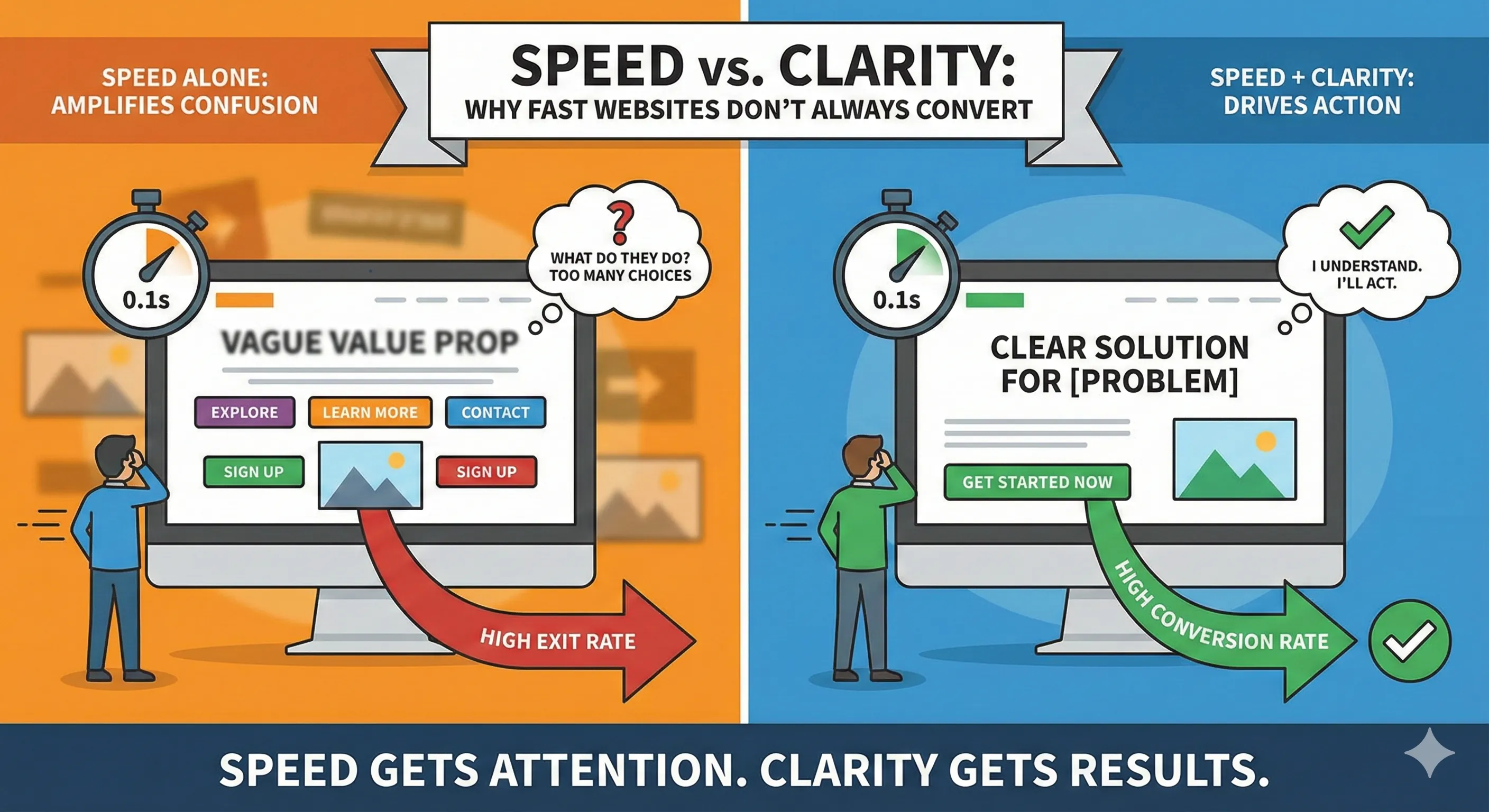
Fast websites rank better, feel better to use, and reduce friction. Load time affects visibility, user experience, and credibility. But speed alone doesn't make a website effective.
This is where a lot of businesses get confused.
They invest in performance optimizations, pass every speed test, and still don't see an increase in leads. The assumption is that something must be broken. In reality, nothing is broken. The site is just fast at doing the wrong thing.
A fast website that doesn't convert is usually missing direction.
When someone lands on a site, speed buys you attention. That attention still has to be used well. If the site loads instantly but doesn't immediately communicate what the business does, who it's for, and what the next step is, the visitor leaves just as fast as they arrived.
Speed amplifies clarity problems.
A slow site gives people time to hesitate. A fast site gives them time to decide. If the decision isn't obvious, speed works against you.
Another common issue is intent mismatch. Many fast websites are optimized technically but disconnected from why people searched in the first place. Visitors arrive expecting a solution and are greeted with branding language, abstract value statements, or generic messaging.
That disconnect kills momentum.
Fast websites also tend to expose trust gaps more clearly. When everything loads quickly, there's nowhere to hide. Visitors immediately assess credibility. If the site feels vague, impersonal, or overly polished without substance, skepticism sets in.
Performance can't compensate for uncertainty.
Another overlooked factor is decision friction. Speed doesn't help if the site asks visitors to make too many choices. Multiple calls to action, competing buttons, and scattered messaging create hesitation. A fast experience that feels chaotic still fails.
High-performing websites are not just fast. They're focused.