Websites
Why Portfolios Don't Belong on Most Business Homepages
Author: Trevor Hunter
Published: October 7, 2025
Portfolios feel safe. They feel like proof. Business owners like them because they show work, effort, and results. Designers like them because they look good. The problem is that on most business websites, portfolios actively work against the goal of the homepage.
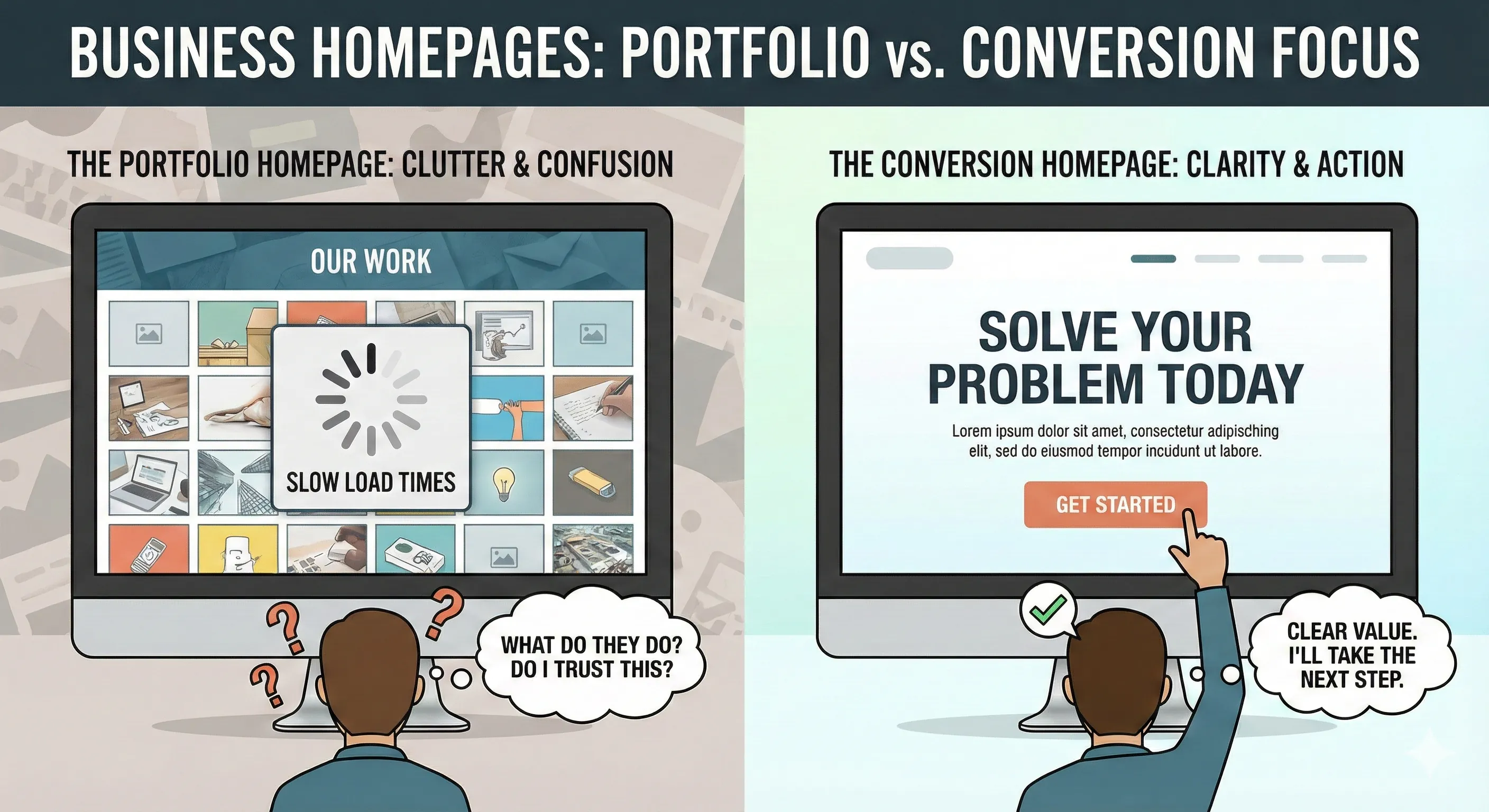
The homepage has one job: help a stranger decide whether to take the next step. It is not there to showcase everything the business has ever done. It is there to reduce uncertainty quickly.
Portfolios do the opposite.
They add weight—both visually and technically. Image-heavy sections slow load times, increase time to interact, and quietly hurt rankings. That alone is a reason to be cautious, but performance isn't the biggest issue. Trust is.
Most visitors do not trust portfolios at face value. They shouldn't. They have no way of knowing whether the images are real, curated, AI-generated, borrowed, or selectively chosen. Even if the work is legitimate, the visitor has no context. Seven great photos tell them nothing about the other seventy jobs they didn't see.
That uncertainty cancels out the intended benefit.
Portfolios also assume people are browsing. They aren't. The majority of visitors never make it past the first scroll. They are deciding, not researching. Asking them to visually evaluate work before they even understand the service is backwards.
There's also a messaging problem. Portfolios shift attention away from the customer and back onto the business. Instead of answering "Can you solve my problem?", the site starts saying "Look at what we've done." That may feel impressive internally, but it doesn't move decisions forward.
In many service industries, results aren't visual anyway. Quality lives in reliability, communication, timing, and follow-through—things a portfolio can't show. In those cases, images create false confidence rather than real trust.
This doesn't mean portfolios are useless. They just don't belong in the highest-stakes real estate on the site. Placing them on secondary pages satisfies internal comfort without interfering with conversion. The people who care will look. Most won't.
Analytics consistently show this. Even on high-traffic sites, portfolio and about pages receive a tiny fraction of visits. The homepage is where decisions are made. Filling it with heavy imagery sacrifices clarity for reassurance that visitors aren't seeking.