Websites
Why DIY Websites Don't Hurt Your Business — They Just Don't Help
Author: Trevor Hunter
Published: July 22, 2025
DIY websites don't usually destroy businesses.
That's why the advice to "just build it yourself" sticks around.
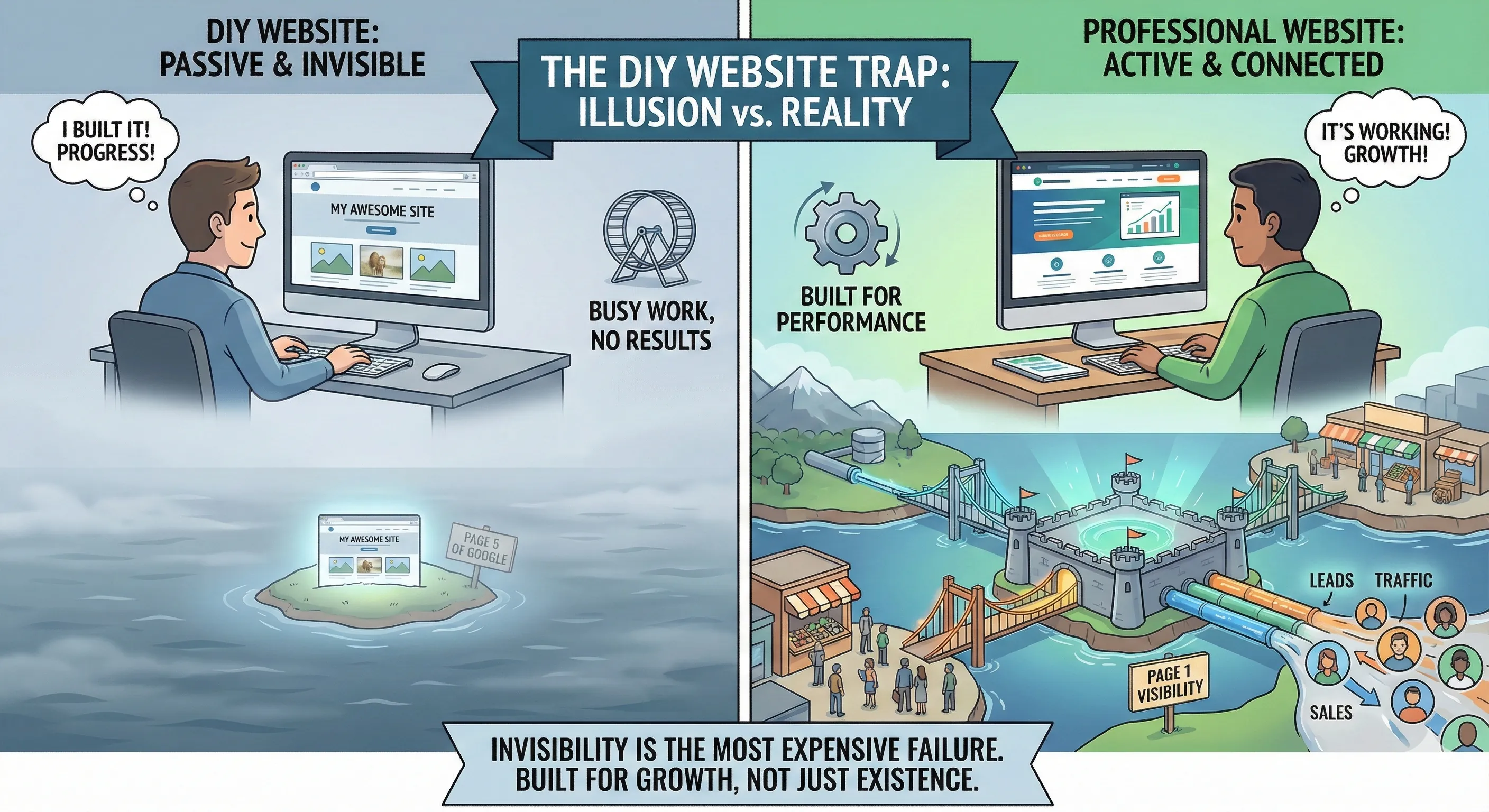
The problem isn’t that these sites actively hurt anything. The problem is that they create the illusion of progress while quietly doing nothing.
When someone builds a website on Squarespace, Wix, or a basic WordPress theme, it often feels productive. Pages are published. Photos are uploaded. A domain goes live. There’s a sense of accomplishment.
But that feeling has almost no relationship to whether the site will ever help the business.
In most cases, DIY websites exist in a vacuum. They don’t rank. They don’t convert. They don’t meaningfully participate in how customers find or choose a business.
They sit on page four or five of Google, unseen by anyone who isn’t already looking for the company by name.
That’s why they don’t technically hurt anything. If no one sees the site, it can’t damage reputation or scare customers away.
But it also can’t generate demand.
And that’s the part people underestimate.
A website that doesn’t help the business grow isn’t neutral. It costs time. It delays real solutions. It convinces owners that “the website is handled,” when it isn’t.
That false sense of completion is expensive.
DIY platforms are designed to make publishing easy, not to make businesses visible. They optimize for convenience, not performance. That’s not a flaw. That’s the product.
The issue comes when business owners expect convenience tools to produce competitive outcomes.
They won’t.
Ranking on Google requires structure, speed, technical compliance, and content that’s built intentionally around search behavior. DIY platforms abstract most of that away. They hide complexity in exchange for simplicity.
That tradeoff is fine if your goal is to have a website.
It’s a problem if your goal is to get customers.
Another misconception is that a DIY site can be “improved later.” In theory, that sounds reasonable. In practice, most of these sites reach a ceiling quickly. The foundational decisions are wrong from the start, and fixing them later often means rebuilding anyway.
So time is spent twice.
There’s also an opportunity cost most owners never calculate. Every month spent relying on a site that doesn’t perform is a month competitors continue capturing demand. Customers don’t wait for you to figure it out. They choose whoever shows up.
DIY websites also tend to prioritize self-expression over clarity. Owners write for themselves. They include long explanations, personal stories, and internal language that makes sense to them but not to customers.
That disconnect isn’t malicious. It’s natural.
But it kills effectiveness.
The harsh truth is that most DIY websites are only ever seen by the person who built them and a handful of friends or family members. They don’t enter the competitive landscape. They don’t compete for attention. They don’t influence decisions.
They exist.
And existence isn’t enough.
None of this means people shouldn’t experiment or learn. Building things yourself is often how understanding develops. But learning and relying are two different things.
If a website is expected to play a real role in customer acquisition, it needs to be treated like infrastructure, not a side project.
DIY websites are fine placeholders.
They are not growth tools.
That distinction matters.
The danger isn’t that a DIY site will ruin your business. The danger is that it will quietly keep you invisible while you assume something is working.
And invisibility is the most expensive failure mode there is.