Websites
What to Fix First on a Website That Isn't Performing
Author: Trevor Hunter
Published: August 17, 2025
When a website isn’t performing, the instinct is to fix everything at once. Add pages. Rewrite copy. Change the design. Run ads. Install new tools. That reaction is understandable, and it’s also the fastest way to waste time and money.
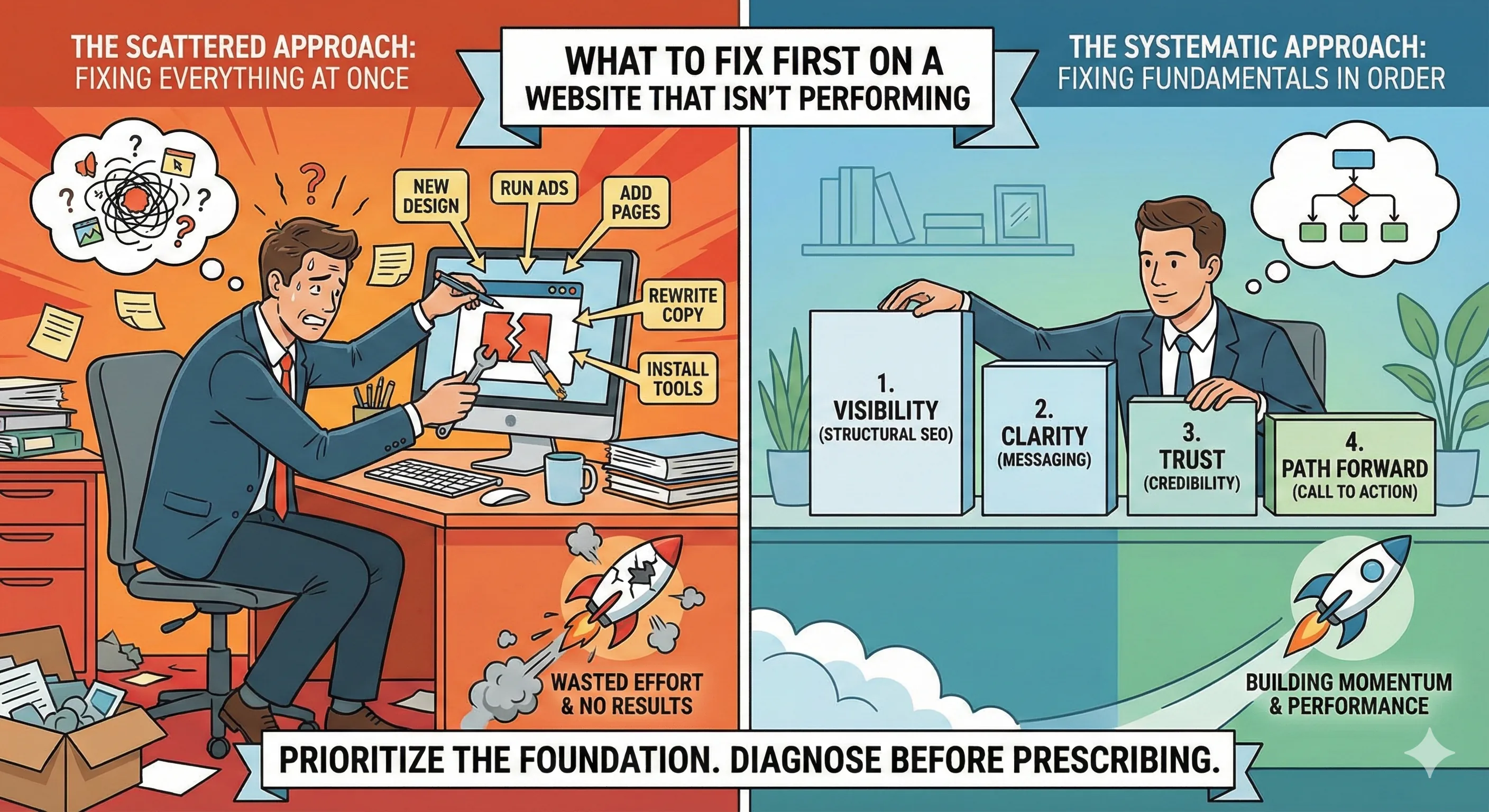
Most underperforming websites don’t suffer from dozens of problems. They suffer from one or two foundational issues that make everything else irrelevant. The mistake most businesses make is treating symptoms instead of causes.
Before touching design, adding features, or rewriting copy, the first thing that needs to be addressed is visibility. If the website isn’t being seen by the right people in the first place, nothing else matters. A perfectly written page that never ranks is still invisible.
This doesn’t mean chasing every SEO tactic or obsessing over algorithm updates. It means confirming that the site is structurally capable of ranking at all. Technical compliance, crawlability, speed, and basic content relevance are table stakes. If those aren’t in place, conversion tweaks won’t move the needle.
A lot of businesses jump straight to aesthetics because design feels tangible. You can see it. You can approve it. You can argue about it. But design does not fix a website that Google can’t properly crawl, index, or understand. A beautiful site that doesn’t rank might as well not exist.
The next thing that typically needs attention is clarity. Once a site is actually being seen, it has a very short window to communicate what it does, who it’s for, and why someone should trust it. Most visitors do not explore. They scan. If the value proposition isn’t immediately obvious, they leave.
This is where many businesses misdiagnose the problem. They assume they need more content when what they really need is clearer content. Adding pages doesn’t help if the core message is muddy. Expanding the site just multiplies confusion.
Another common mistake is layering tools on top of a broken foundation. Chat widgets, analytics platforms, heatmaps, popups, and automation don’t fix a site that isn’t visible or understandable. They just add complexity to something that already isn’t working.
Advertising is often treated as the shortcut. When organic performance is poor, businesses throw money at ads hoping to compensate. The problem is that ads amplify whatever they point to. Sending paid traffic to a structurally broken site is one of the fastest ways to burn cash.
A website should earn the right to run ads. That means it can rank, load quickly, communicate clearly, and convert at a basic level. Ads should accelerate something that already works, not prop up something that doesn’t.
In most cases, fixing a website comes down to asking a few uncomfortable questions. Can this site actually rank? Does it clearly explain what the business does within seconds? Is it built in a way that search engines can understand and trust?
When those fundamentals are addressed, many of the problems people want to fix disappear on their own. Traffic improves. Conversions increase. Confidence returns. The site starts working as a system instead of a liability.
Fixing everything at once feels productive, but it usually isn’t. The smartest move is to identify the one or two foundational issues holding everything back and fix those first. Everything else only matters once those are solved.