Business Fundamentals
What to Fix First When a Business Feels Stuck
Author: Trevor Hunter
Published: September 5, 2025
When a business feels stuck, most owners react the same way.
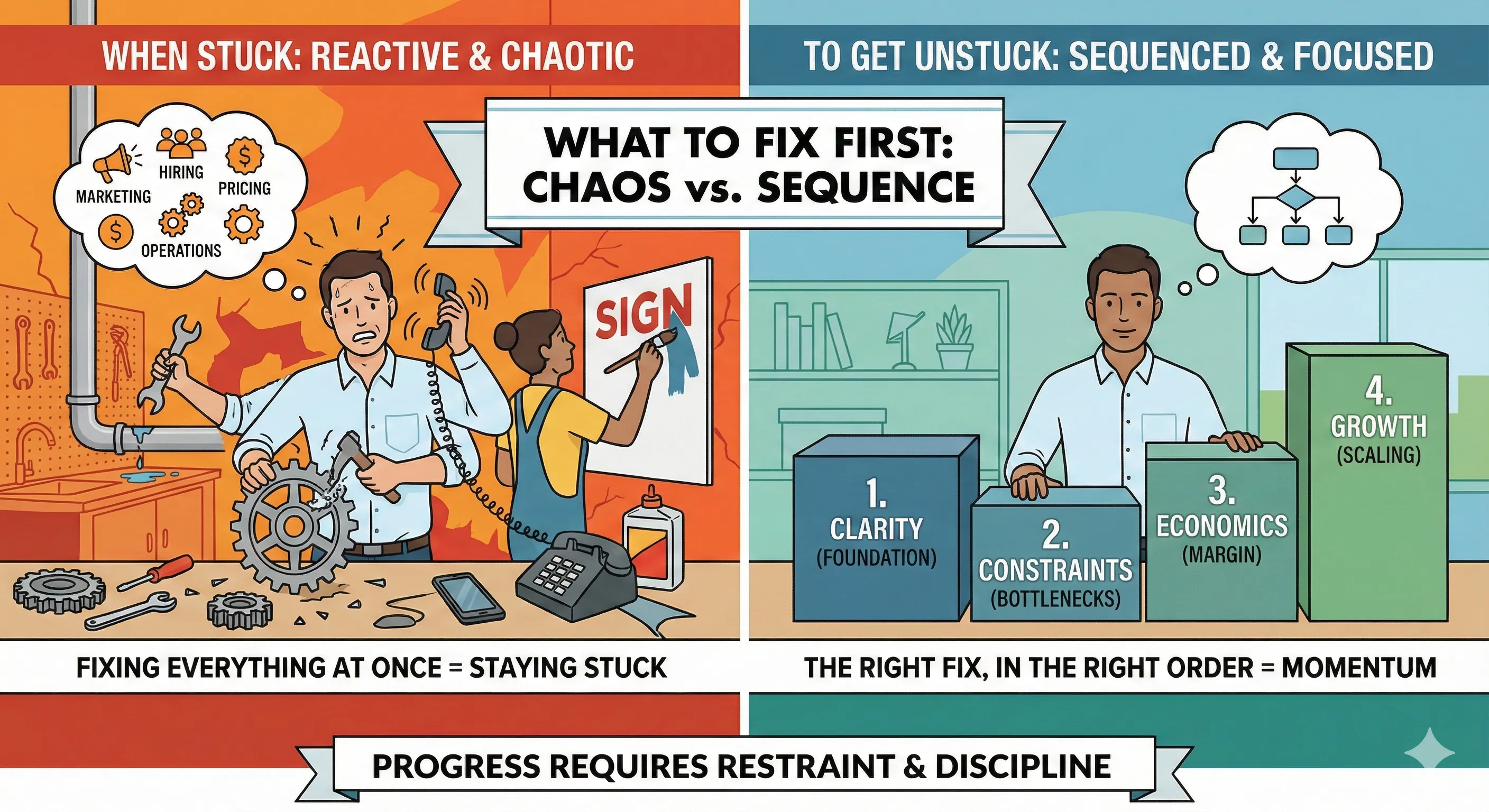
They try to fix everything.
They brainstorm new ideas. They chase new opportunities. They tweak pricing, marketing, hiring, operations — all at once. Activity ramps up, but clarity doesn't.
That's how you stay stuck while convincing yourself you're moving.
Feeling stuck isn't a signal that nothing is working. It's a signal that something important isn't.
The mistake is treating that feeling like a motivation problem instead of a sequencing problem.
Most businesses don't need a big idea. They need the right fix, in the right order.
Stuck businesses usually have one dominant constraint, not ten. Everything else is downstream of it.
The hard part is identifying which problem is actually first.
Owners often default to the most visible issue. Sales feel slow, so they chase demand. Teams feel overwhelmed, so they hire. Margins feel tight, so they cut costs.
Those reactions make sense. They're just often out of order.
Fixing the wrong thing first creates more pressure, not less.
A common example is chasing growth when delivery is already strained. The business feels flat, so the owner looks for more work. More work arrives, and suddenly the team is drowning.
The original problem wasn't demand. It was capacity.
Another example is hiring before expectations are clear. Owners feel overwhelmed, so they bring someone in quickly. The workload shifts, but confusion increases. The owner spends more time managing than before.
The original problem wasn't headcount. It was clarity.
This is why sequencing matters.
When a business feels stuck, the first thing to fix is almost always clarity.
Clarity around what the business actually does best.
Clarity around who it's for.
Clarity around how work moves from start to finish.
Without that, every other fix is guesswork.
The next thing to look at is constraints.
Where does work slow down?
Where do decisions pile up?
Where does quality drop under pressure?
Those points reveal what's limiting progress. Fixing anything else before addressing the constraint just shifts stress around.