Business Fundamentals
What Stability Actually Looks Like in a Small Business
Author: Trevor Hunter
Published: July 8, 2025
Stability is one of the most misunderstood goals in small business.
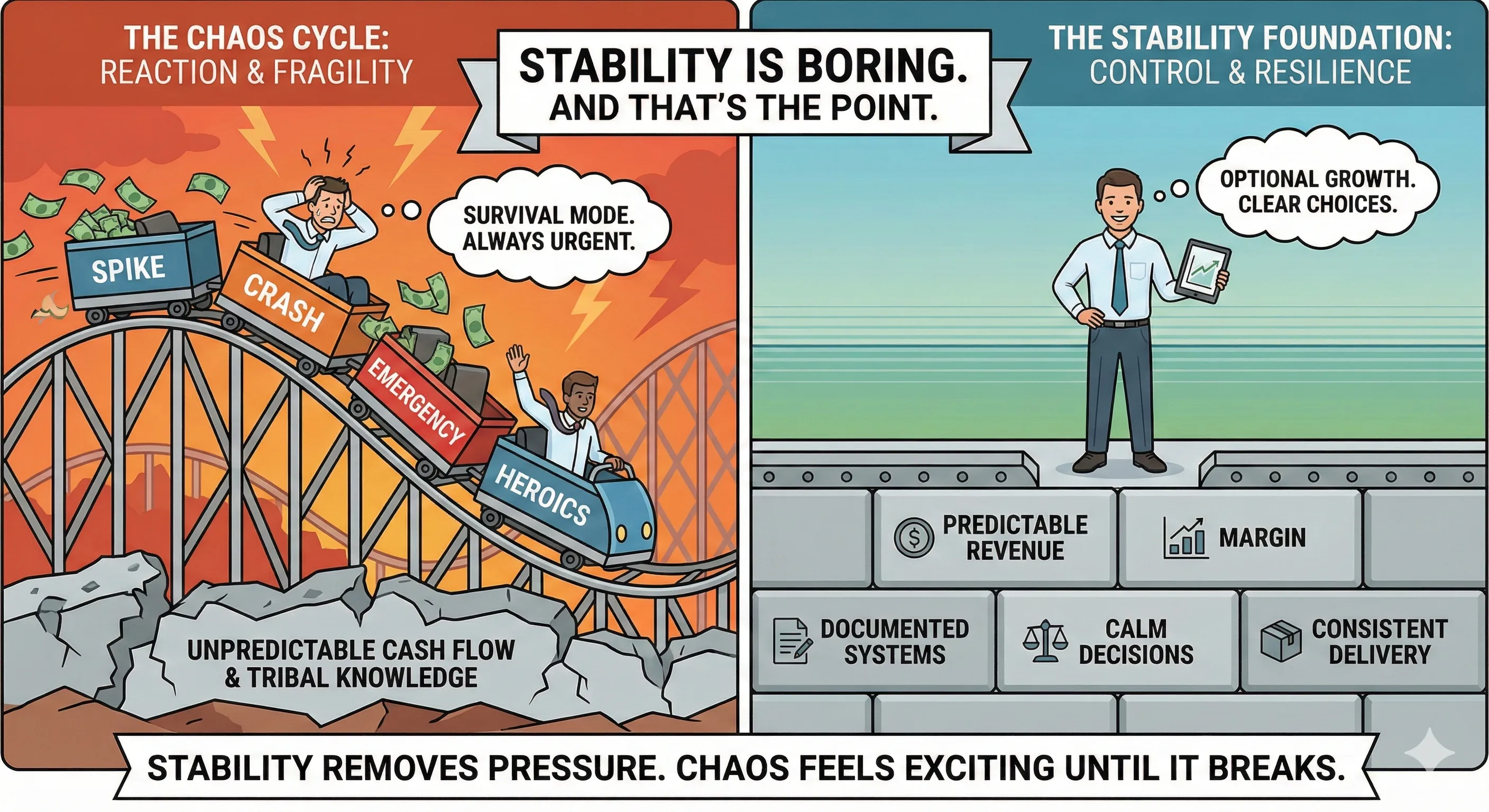
People talk about it like it's a lack of ambition. Like choosing stability means you gave up on growth, excitement, or upside.
That's backwards.
Most businesses don't fail because they aimed too low. They fail because they never built anything steady enough to stand on.
When people imagine a "successful" business, they picture momentum. Fast growth. Big months. Lots of activity. New hires. New opportunities.
Stability doesn't look like that.
Stability looks boring.
That's why so many owners accidentally avoid it.
A stable business isn't loud. It doesn't spike and crash. It doesn't rely on heroics. It doesn't need constant attention to keep running.
It shows up the same way month after month.
Revenue is predictable.
Costs are understood.
Cash flow is boring in the best way.
Nothing feels urgent all the time.
That calmness can feel uncomfortable if you're used to chaos. Some owners mistake it for stagnation.
It's not.
It's control.
Stability starts with predictability. Not perfection, but consistency. You know roughly what's coming in. You know roughly what's going out. You're not surprised every time you open the bank account.
Most small businesses live in a state of constant reaction. One good month followed by two stressful ones. A big client saves the quarter. A slow period creates panic.
That rollercoaster becomes normal.
But it's not healthy.
A stable business smooths those swings. It doesn't eliminate variability, but it absorbs it.
That requires margin.
Margin is what turns problems into inconveniences instead of emergencies. Without it, every issue feels existential.
Stability also shows up in operations.
Work happens the same way whether the owner is present or not. Customers get a consistent experience. The team knows what to do without constant direction.
Nothing depends on memory alone.
This is where many businesses struggle. They run on tribal knowledge. Everyone knows how things work because they've been there long enough.
That's fragile.