Business Fundamentals
What Actually Breaks When a Business Starts Growing
Author: Trevor Hunter
Published: August 22, 2025
Most people think growth breaks a business.
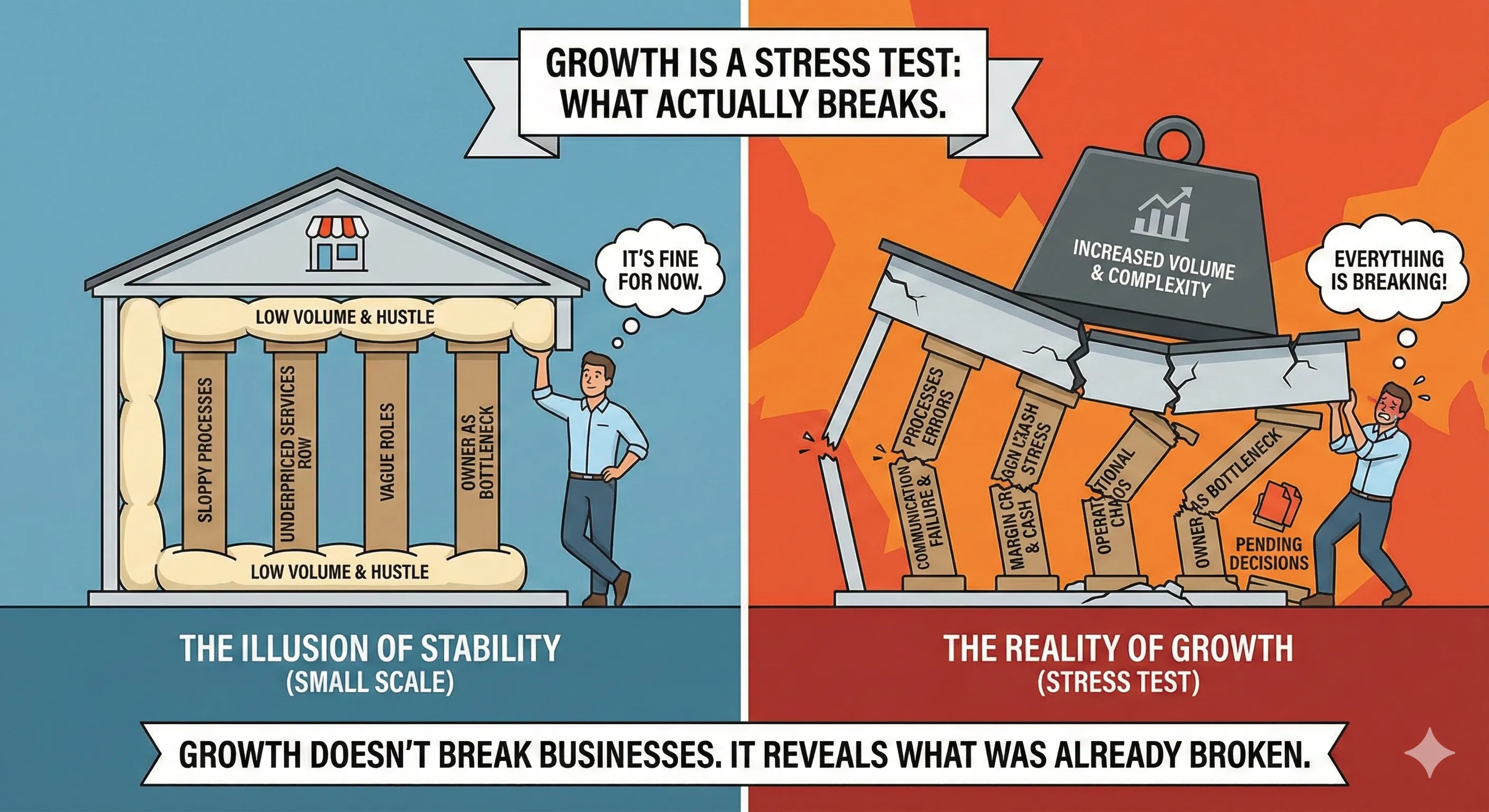
It doesn't.
Growth just removes the padding.
When a business is small, it can get away with a lot. Sloppy processes. Vague roles. Pricing that's a little too low. Owners doing ten different jobs at once. Customers waiting longer than they should. Nothing's ideal, but nothing is catastrophic either.
Then the business starts to grow.
More customers. More work. More moving parts.
And suddenly everything that was "fine for now" isn't fine anymore.
That's when people panic and blame growth.
But growth isn't the problem. Growth is the stress test.
The first thing that usually breaks is communication. When there are only a few people involved, information lives in conversations and memory. Everyone knows what's going on because everyone is involved in everything.
As volume increases, that stops working.
Details get missed. Expectations aren't clear. Someone assumes someone else handled it. Customers feel the gaps before the business does.
This isn't a people problem. It's a structure problem.
The second thing that breaks is decision-making. In a small business, decisions are fast because the owner touches everything. That works until it doesn't.
As soon as the owner becomes the bottleneck for approvals, answers, and fixes, speed dies. Work piles up. People wait. Momentum slows.
From the outside, it looks like the team isn't capable.
From the inside, it's obvious: everything still routes through one person.
Another common failure point is pricing.
Underpriced services are survivable at low volume because the owner is often absorbing the cost with their own time. When volume increases, that hidden subsidy explodes.
Margins shrink.
Stress rises.
Cash feels tight even though revenue is up.
This is where owners get confused. They're busier than ever, making more money than ever, and somehow feel worse off.
That's not bad luck. That's math catching up.
Operations are the next thing to crack.
What used to be handled informally—scheduling, handoffs, follow-ups—now needs to happen consistently. When systems don't exist, people invent their own ways of doing things. That creates variation. Variation creates mistakes.
Customers don't experience your intent. They experience your execution.
Growth magnifies execution.
Hiring is another pressure point. Early hires are often made out of urgency rather than clarity. Someone is overloaded, so help is added quickly. Roles blur. Expectations stay fuzzy.
It works until it doesn't.
As the team grows, those early shortcuts compound. Performance becomes uneven. Accountability gets uncomfortable. The owner starts stepping back in to "help," which only reinforces dependency.