Business Fundamentals
The Business Coaching Scam Nobody Wants to Call Out
Author: Trevor Hunter
Published: October 14, 2025
The internet is flooded with business coaches, and most of them are selling the same thing: hope wrapped in confidence. Work less. Make more. Scale faster. Charge premium prices. Unlock the next level. The language is polished, the promises are bold, and the results are conveniently vague.
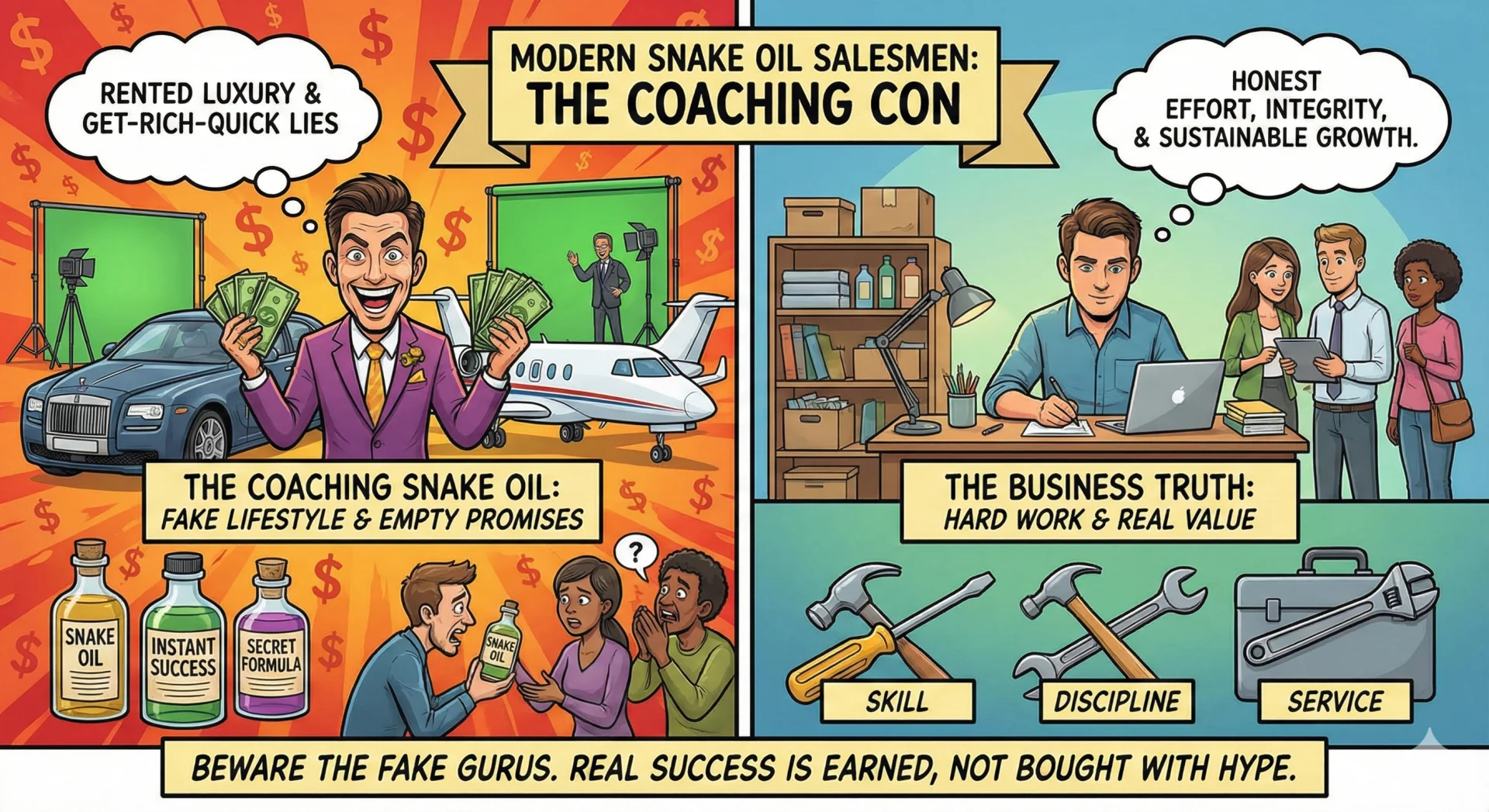
What they rarely sell is anything tied to reality. Real businesses are messy. They involve payroll stress, cash flow problems, missed deadlines, angry customers, equipment failures, and long nights trying to figure out how to keep everything moving. Most coaches have never lived inside that reality. Many of them have built exactly one thing: a coaching program.
That distinction matters more than people want to admit. The coaching industry thrives in a space where accountability is optional. When advice doesn’t work, the failure gets reframed as mindset, effort, or belief. The system never takes responsibility. The client always does. That’s not guidance. That’s insulation.
Most coaching content isn’t original. It’s recycled. It’s repackaged advice pulled from people who actually built something. The irony is that those people give away massive amounts of useful information for free. The coaching industry simply curates it, rebrands it, and charges thousands of dollars for access to it.
The promise is seductive because it sounds easier than reality. Coaches sell shortcuts because shortcuts sell. They rarely talk about infrastructure, timing, capacity, or operational friction. Those topics don’t fit neatly into frameworks or social media clips, and they don’t create fast wins.
Real business growth is slow and constrained. It’s limited by people, systems, cash flow, and demand. Coaches prefer abstractions because abstractions don’t require proof. Anyone can talk about mindset. Very few can talk about fixing bottlenecks without breaking something else.
Another red flag is universality. One process supposedly works for every industry, every market, every business size. That’s nonsense. A landscaping company, a law firm, and a local service business do not scale the same way. Pretending they do is lazy at best and dishonest at worst.
There’s also success theater. Coaches showcase outliers as proof. One client who succeeded becomes marketing material for everyone else. What’s never shown are the dozens who didn’t see results, quietly churned out and blamed themselves. Coaches don’t fail publicly. Clients do.
The most dangerous part of the coaching industry is how it shifts focus away from fundamentals. Instead of fixing broken systems, owners are encouraged to tweak mindset, raise prices prematurely, or scale before they’re ready. That creates fragility, not growth.
Most small businesses don’t need motivation. They need clarity. They need systems that work. They need visibility. They need fewer variables, not more inspiration. Mentorship can matter, but it doesn’t require expensive packages or charismatic gurus. It requires honesty, pattern recognition, and discipline.
The best advice is often boring. It’s specific. It’s grounded in tradeoffs. It acknowledges constraints. That doesn’t sell well, so it gets ignored. The coaching industry survives by selling certainty in an uncertain environment.
If a coach can’t explain how their advice applies to your specific business, they’re not coaching. They’re performing. You don’t need someone to tell you to work harder or think bigger. You need someone or something that addresses the actual bottleneck in your business.
Most of the time, that bottleneck isn’t mindset. It’s reality.