Business Fundamentals
Why Systems Matter More Than Talent
Author: Trevor Hunter
Published: September 2, 2025
Talent gets a lot of credit in business.
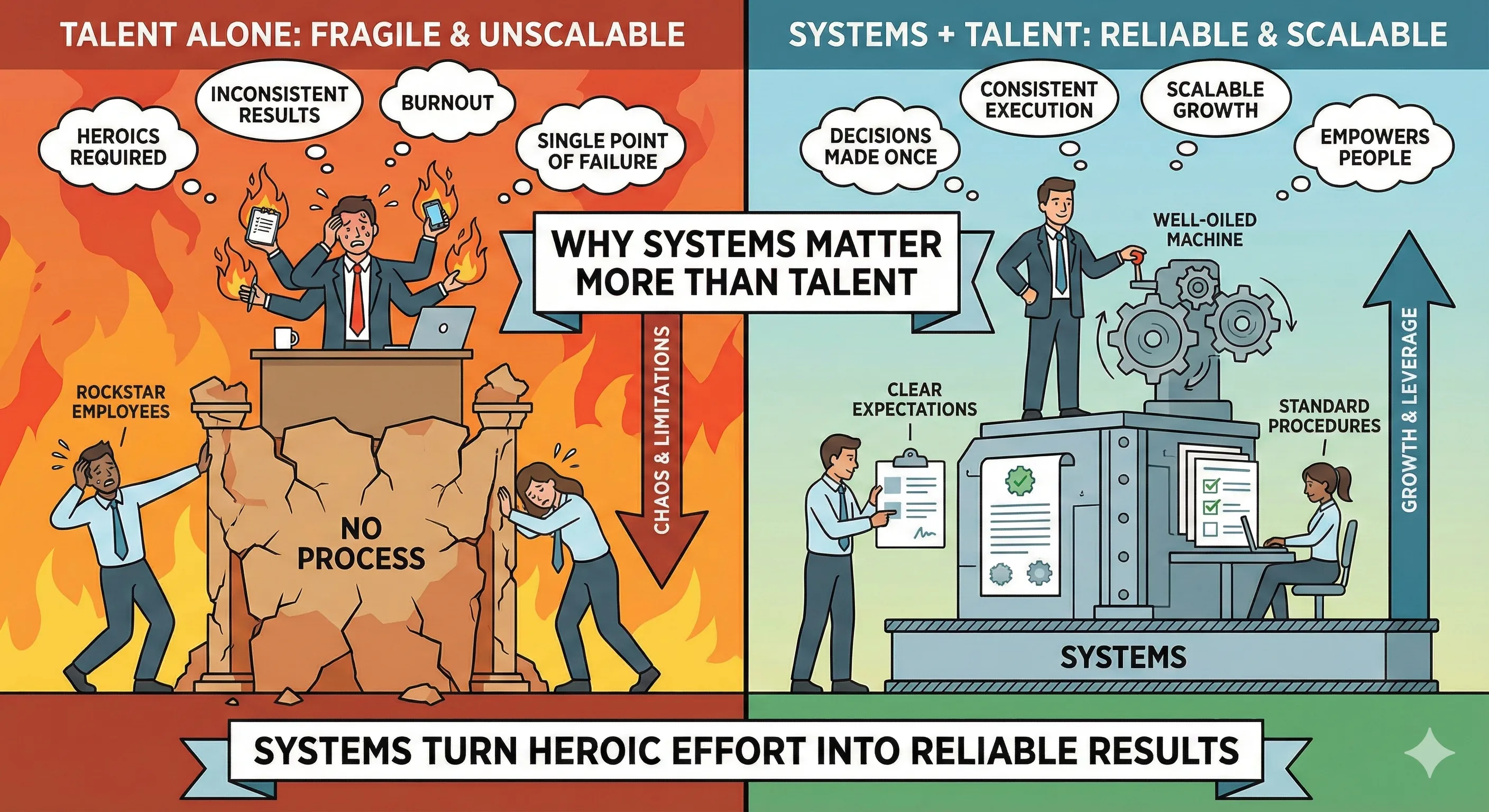
When things go well, people praise the rockstars. When things fall apart, owners say they just need better people.
That belief feels logical.
It's also usually wrong.
Talented people don't save broken systems. They just survive them longer.
In small businesses especially, early success often comes from individual effort. Someone works harder, moves faster, stays later, and figures things out on the fly. That person becomes indispensable.
For a while, it works.
Then the business grows.
Volume increases. Complexity increases. More decisions need to be made more often. And suddenly, talent alone isn't enough.
This is where cracks appear.
The same person who once carried everything starts dropping balls. Not because they've changed, but because the load has.
Owners respond by trying to hire more talent.
Another strong performer. Another experienced hire. Another "A player."
And for a moment, it feels better.
Then the same problems resurface.
Missed details.
Inconsistent execution.
Different answers depending on who's working.
At that point, the issue isn't talent. It's the absence of systems.
A system is simply a decision made once so it doesn't have to be made again.
It defines how something happens, not who makes it happen.
Without systems, every task becomes a judgment call. Judgment calls are exhausting. They slow things down. They introduce variation.
Variation is the enemy of scale.
Talented people thrive in good systems because systems remove unnecessary friction. They clarify expectations. They reduce second-guessing. They free up mental energy for the work that actually requires skill.
In bad systems, talent gets wasted.
People spend their time compensating for gaps instead of producing value. They invent their own ways of doing things. They solve the same problems repeatedly because nothing is documented or standardized.
From the outside, it looks like chaos.
From the inside, it feels like constant effort with diminishing returns.
This is where burnout creeps in.