Business Fundamentals
Why Simple Businesses Often Perform Better
Author: Trevor Hunter
Published: July 15, 2025
Simple businesses tend to make people uneasy.
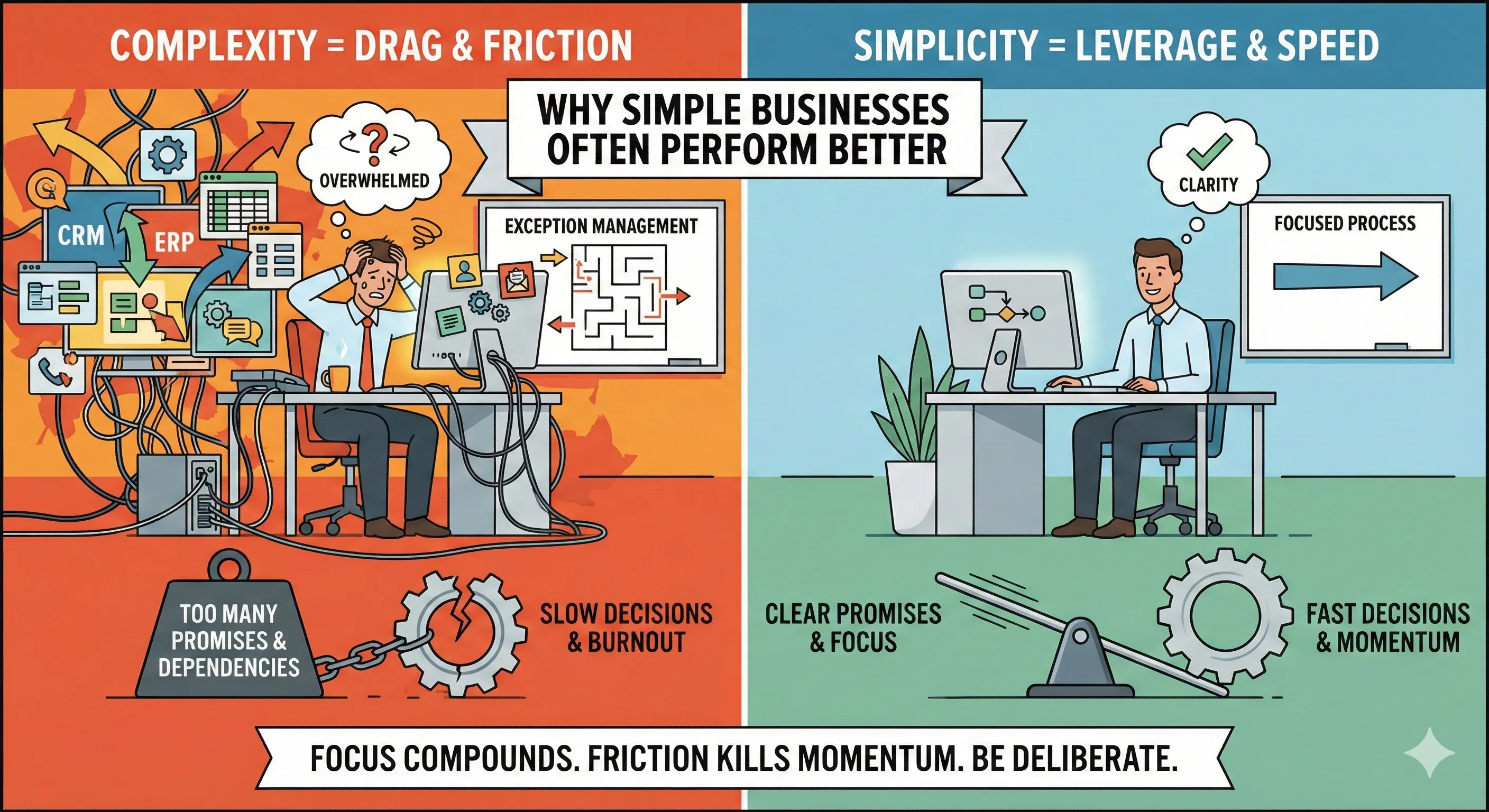
They don't look busy. They don't advertise complexity. They don't talk about everything they do.
From the outside, they can even look underbuilt.
And yet, they often outperform businesses that appear far more sophisticated.
This isn't an accident.
Complexity feels like progress. Simplicity feels like risk.
Adding services, tools, processes, and exceptions gives the impression that the business is evolving. Removing things feels like giving something up.
So most businesses accumulate complexity over time.
They add offerings to capture edge cases. They introduce new tools to solve one-off problems. They create workarounds instead of fixing root causes.
None of those decisions feel wrong in isolation.
Together, they create drag.
Simple businesses make fewer promises. That's one of their biggest advantages.
When the scope is narrow, expectations are clearer. Delivery is more consistent. Decisions are easier because fewer variables are involved.
Complex businesses have to manage exceptions constantly. Each exception requires judgment. Judgment requires time and attention.
That attention usually comes from the owner.
This is why complex businesses often feel fragile. Too many things depend on specific people knowing specific details. When someone is out, things slow down. When volume increases, cracks appear.
Simple businesses are easier to operate because fewer things can break.
That doesn't mean they're unsophisticated. It means they're focused.
Focus compounds.