Business Fundamentals
Why Most Businesses Plateau Before They Fail
Author: Trevor Hunter
Published: June 2, 2025
Most businesses don't fail in a dramatic way.
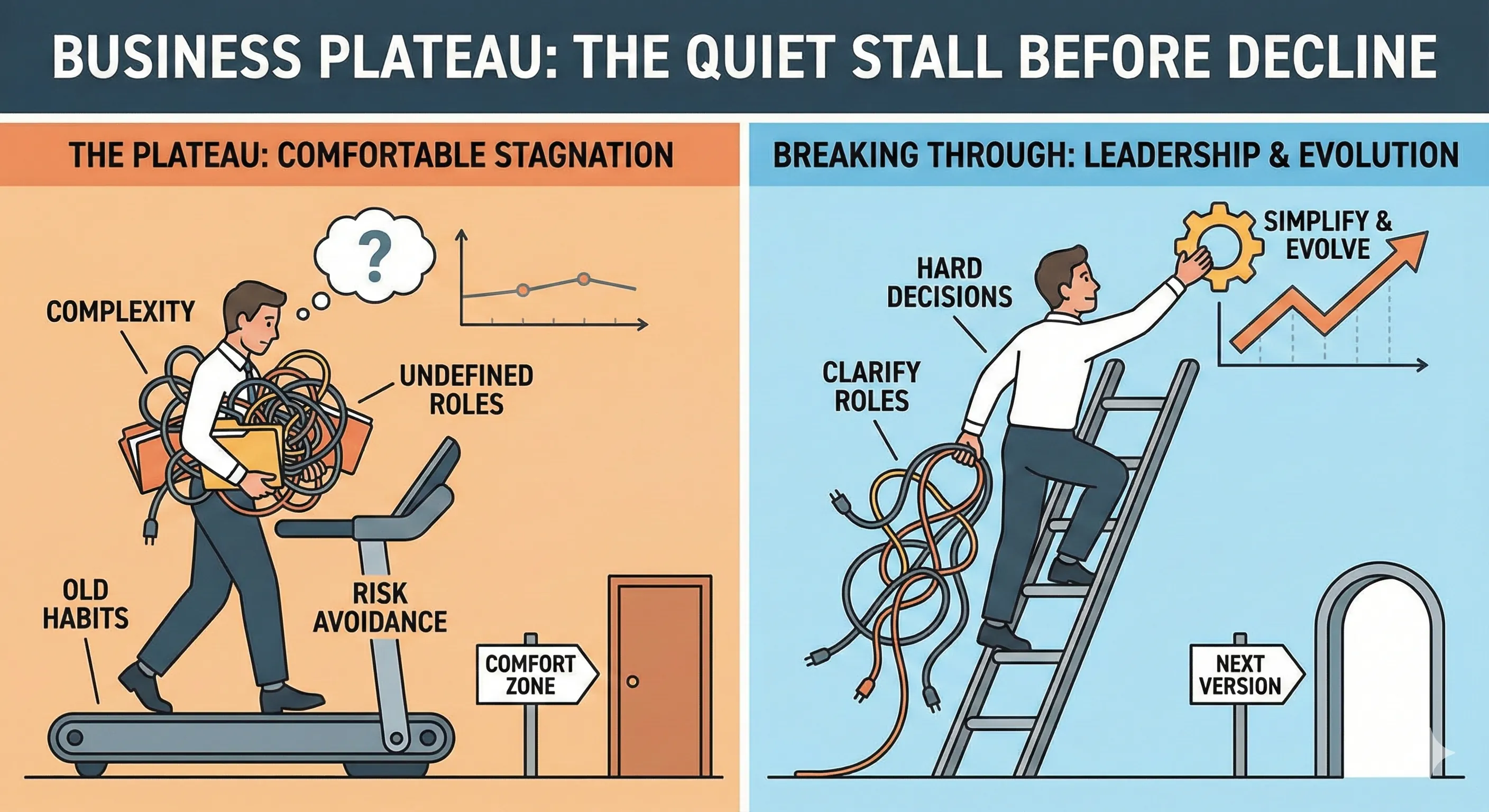
They don't crash overnight. They don't implode after one bad decision. They don't suddenly disappear.
They stall.
Revenue flattens. Energy drops. Progress slows. Nothing is technically broken, but nothing is really improving either.
That plateau is where most businesses spend their final years.
It's uncomfortable because it doesn't feel like failure. From the outside, things look fine. The business still operates. Customers still come in. Bills still get paid.
But momentum is gone.
This is the phase where owners get frustrated and confused. They try new things. They change tactics. They look for a spark.
What they're actually missing is that the business has stopped evolving.
Plateaus happen when a business outgrows the decisions that built it.
Early success usually comes from scrappiness. Owners hustle. They adapt quickly. They do whatever is needed to make things work. That flexibility is an advantage at small scale.
Eventually, it becomes a liability.
The habits that once created growth start capping it.
Processes stay informal. Roles stay blurry. Decisions stay centralized. Pricing stays conservative.
None of those things cause immediate failure. They just quietly limit what's possible.
At some point, the business reaches the ceiling of its current structure.
More effort doesn't help.
More hours don't help.
More urgency doesn't help.
That's when owners start feeling stuck.
Another reason businesses plateau is risk avoidance. Once a business is stable enough to support the owner, fear increases. There's more to lose.
Decisions get safer.
Experiments get smaller.
Change slows down.
Ironically, that caution accelerates decline.
Markets shift. Customers change. Costs rise. Businesses that don't adapt gradually fall behind.
Plateaus are comfortable enough to ignore but dangerous enough to erode margins over time.