Business Fundamentals
Most Small Businesses Don’t Need More Leads
Author: Trevor Hunter
Published: October 25, 2025
Most small businesses don’t have a lead problem. They have a retention problem. And it’s usually hiding in plain sight because nobody wants to look at the numbers honestly.
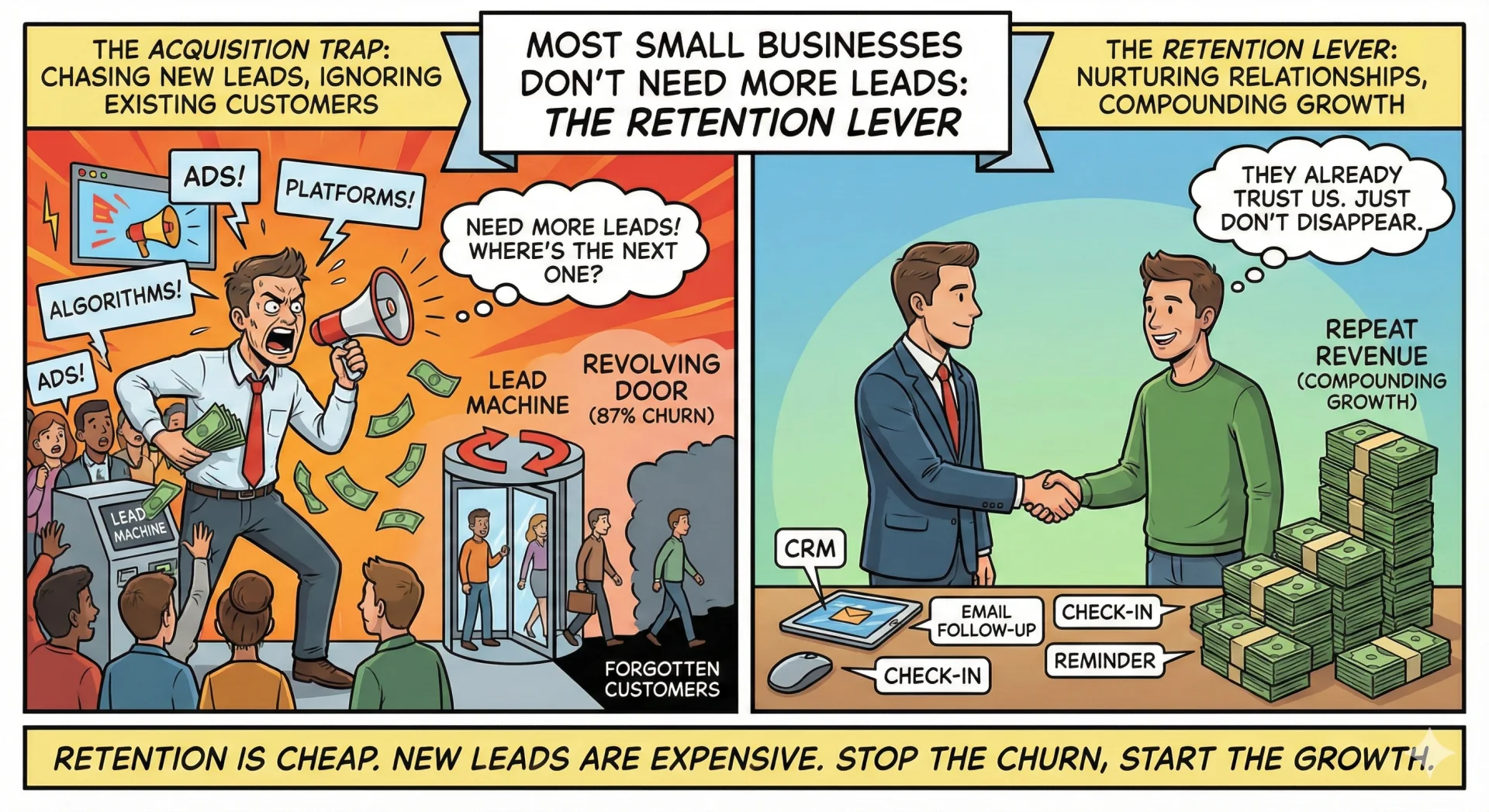
I just looked at a real service business. Not a hypothetical. Not a case study cherry-picked to make a point. A real company. Over the past few years, they served 406 customers. Guess how many came back. Seventy-seven. That’s it. Three hundred and twenty-nine customers disappeared without a trace. That’s an 87 percent churn rate, and nobody inside the business thought it was a problem.
They did forty-five thousand dollars in revenue this year and assumed demand was the issue. It wasn’t. Retention was. The math makes that painfully obvious. Their average ticket was three hundred seventy-seven dollars and one cent. If those same 406 customers came back just once per year, that’s one hundred fifty-three thousand dollars in revenue. Twice per year? Three hundred six thousand dollars. Same service. Same customers. Zero additional ad spend.
This is the part that should piss business owners off. They’re out here obsessing over ads, platforms, algorithms, and lead sources while letting existing customers walk away like the interaction never mattered. No follow-up. No check-in. No reason to come back. Just silence.
Businesses act like retention is complicated. It isn’t. It’s just unsexy. There’s no dopamine hit. No flashy dashboard. No guru package to buy. It’s basic human behavior. People come back to businesses that acknowledge them after the sale.
Most owners treat customers like a one-night stand. Get the job done, get paid, move on to the next one. Then they wonder why growth stalls. You don’t build a business that way. You build a revolving door.
Retention doesn’t mean begging. It doesn’t mean discounts. It doesn’t mean annoying people. It means staying present. A check-in. A reminder. A follow-up. A simple "hey, how did everything hold up" months later. That’s it.
Today, there are hundreds of ways to do this. Email. Text. CRM reminders. Social media. Direct mail. Automated follow-ups. Personal follow-ups. There is no shortage of tools. The only shortage is effort.
The irony is that retention is the easiest growth strategy in business. These people already trusted you once. They already paid you once. You already solved a problem for them once. You don’t have to convince them you’re real. You just have to not disappear.
Instead, most businesses chase new leads like a desperate ex, throwing money at ads while ignoring the people who already said yes. That’s backwards. New leads are expensive. Retention is cheap. New leads require persuasion. Retention requires remembering someone exists.
If you want to grow without blowing up your budget, stop asking how to get more customers and start asking why the ones you already have never come back. The answers are usually uncomfortable, but they’re also actionable.
Most small businesses don’t need better ads. They need to give a damn after the first sale.
Retention isn’t sexy. It’s not flashy. But it works. And the math doesn’t lie.