Business Fundamentals
Most Businesses Don't Lose Customers — They Wear Them Out
Author: Trevor Hunter
Published: August 28, 2025
Most businesses don’t lose customers because of one catastrophic mistake. They lose them slowly. Quietly. Through friction, delays, and small moments that stack up until the customer simply stops caring.
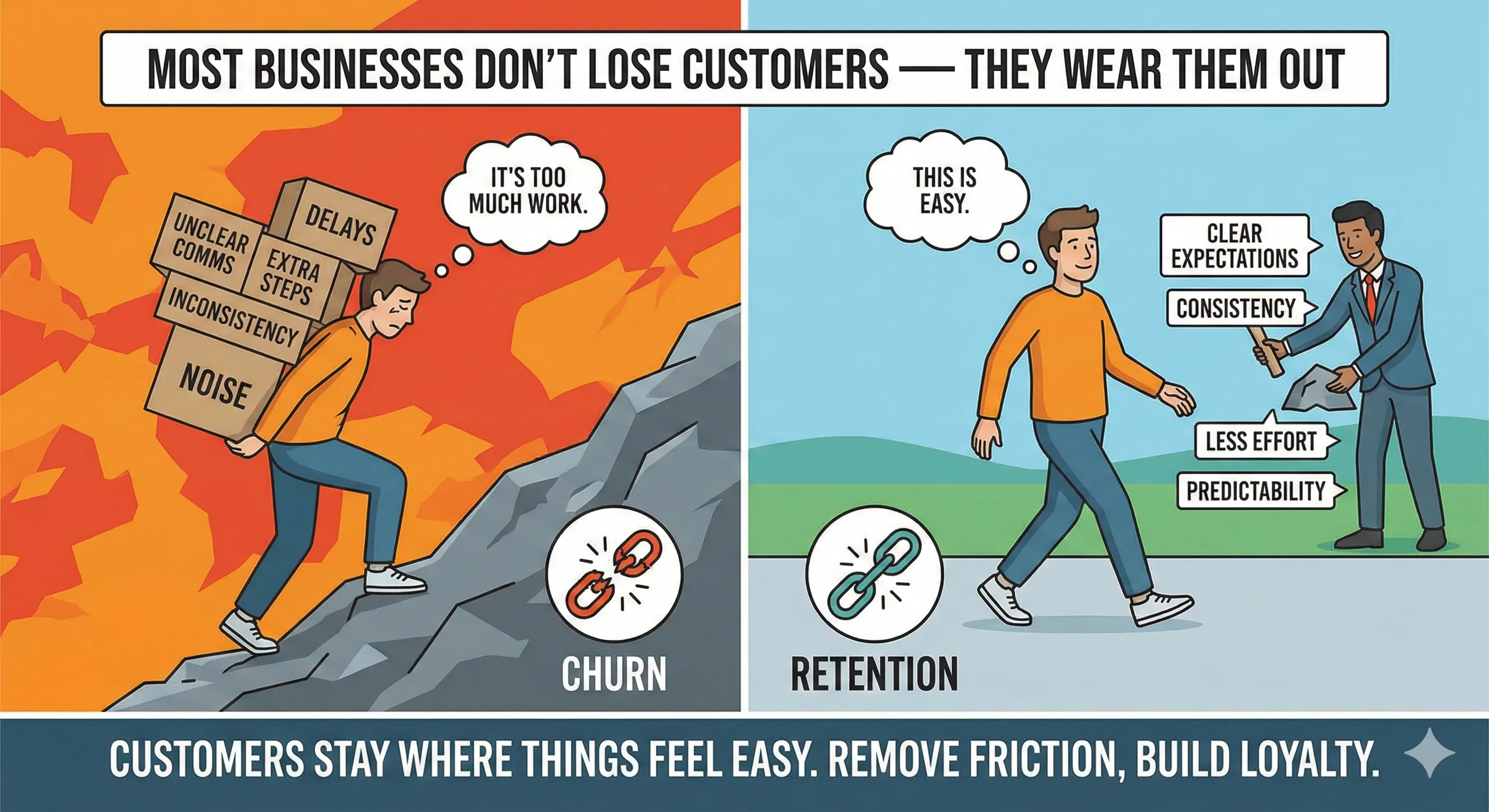
Customers rarely leave angry. They drift. A call doesn’t get returned. A quote takes too long. An email goes unanswered. A small issue turns into a hassle. None of it feels serious in isolation, but together it creates exhaustion.
From the business side, nothing feels broken. Jobs are getting done. Revenue is coming in. Complaints are minimal. From the customer’s side, the experience feels heavier than it should.
That’s how customers get worn out.
Most owners assume churn happens when something goes wrong. A bad job. A missed deadline. A mistake. Those things do cause losses, but they’re not the primary reason customers disappear. The primary reason is friction.
Friction shows up in small ways. Unclear communication. Vague timelines. Having to follow up repeatedly. Not knowing who to contact. Waiting longer than expected for simple answers. These moments don’t trigger outrage. They trigger disengagement.
When customers have to work harder than they expected, they start mentally checking out.
One of the biggest contributors to wear-out is inconsistency. Different answers from different people. Different processes depending on the day. Different expectations depending on who they talk to. Customers shouldn’t have to relearn how to work with a business every time.
Another issue is delay. Not just long delays, but unexplained ones. People are surprisingly patient when they know what’s happening. They get frustrated when they don’t. Silence creates uncertainty, and uncertainty creates fatigue.
Most businesses underestimate how draining uncertainty is. Customers don’t want perfection. They want clarity.
Over time, customers start making small adjustments. They stop calling first. They stop asking questions. They stop expecting proactive communication. Eventually, when they need the service again, they don’t think of the business at all. They just move on.
From the outside, it looks like churn. From the inside, it feels like bad luck. In reality, it’s erosion.
Another reason businesses wear customers out is by making everything harder than it needs to be. Overcomplicated processes. Too many steps. Too many rules. Too many hoops. What feels like structure internally often feels like friction externally.
This is especially common in service businesses. Owners add layers to protect themselves from edge cases, but those layers become obstacles for normal customers. The experience becomes rigid instead of smooth.
Customers don’t announce when they’re getting tired. They don’t send warning emails. They don’t ask for exit interviews. They just slowly disengage.
By the time a business notices retention is a problem, most of the damage has already been done.
The fix isn’t flashy. It’s not a new CRM or loyalty program. It’s removing friction. Tightening communication. Setting expectations clearly and meeting them consistently.
It’s responding when you say you will. Explaining delays before customers ask. Making it easy to do business with you.
Retention isn’t built on grand gestures. It’s built on reliability.
Most businesses don’t need more leads. They need fewer reasons for customers to quietly give up.
Customers don’t leave because something went wrong. They leave because staying started to feel like work.
If you want customers to stick around, the job isn’t to impress them once. It’s to stop wearing them out over time.