Websites
How Much Should a Small Business Website Cost in 2026?
Author: Trevor Hunter
Published: December 28, 2025
This is one of the most common questions business owners ask, and almost nobody gives a straight answer.
That’s usually because the honest answer isn’t a single number.
The cost of a small business website in 2026 depends entirely on what you expect it to do. Not how it looks. Not how many pages it has. What it's actually responsible for inside the business.
A website that exists just to say “we’re real” is cheap. It can be built quickly, hosted anywhere, and forgotten about. It won’t help much, but it won’t cost much either.
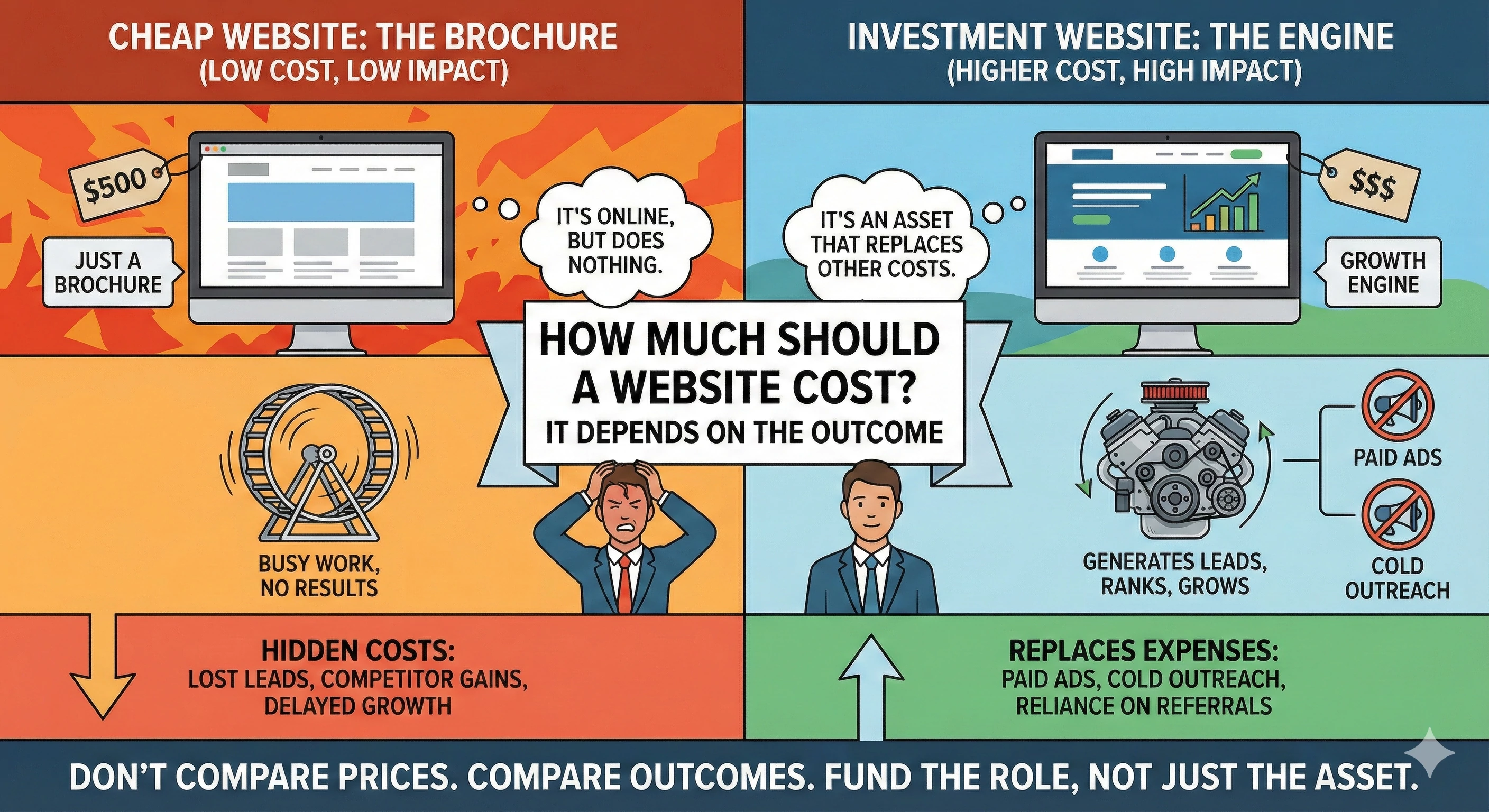
A website that’s expected to generate leads, rank on Google, and support growth is a completely different asset.
That’s where most confusion comes from. Business owners compare prices without comparing outcomes.
A $500 website and a $10,000 website might look similar on the surface. Same number of pages. Same basic layout. Same stock photos.
What’s different is the infrastructure underneath.
A properly built website requires time spent on things most people never see: structure, performance, accessibility, content hierarchy, internal linking, crawlability, and technical compliance. These are not cosmetic details. They are the difference between a site that ranks and one that never will.
Cheap websites skip this work entirely or apply it inconsistently. They rely on templates, plugins, and shortcuts. That’s why they’re cheap.
The problem is that businesses are often sold these sites as “good enough.”
They’re not.
If your expectation is that a website will help you show up when people search for your service, bring in phone calls, and create steady inbound demand, then cost has to be evaluated as an investment, not a purchase.
In that context, the question isn’t “how much does it cost?”
It’s “what does it replace?”
A functioning website can replace:
- paid ads
- cold outreach
- reliance on referrals alone
- inconsistent lead flow
When it works, it changes how the business acquires customers.
That’s why pricing varies so widely. Some businesses need a simple foundation. Others need a full rebuild of how they show up online. Some are starting from nothing. Others are undoing years of bad decisions.
Another factor most people underestimate is opportunity cost. A website that doesn’t work doesn’t just sit there harmlessly. It delays growth. It sends people to competitors. It creates the illusion that marketing has been addressed when it hasn’t.
That’s expensive.
There’s also a dangerous middle ground where businesses spend just enough to feel like they’ve invested, but not enough to get results. This is where most frustration lives. Money was spent. Nothing changed. Confidence drops.
That experience makes owners skeptical, not because websites don’t work, but because the wrong thing was built.
In 2026, the businesses that win online aren't the ones spending the least. They're the ones spending intentionally. They know what the website is responsible for, and they fund it accordingly.
If you’re asking how much a website should cost, the better question is what role it plays in your business. Once that’s clear, the number usually makes a lot more sense.
Cheap websites aren’t bad because they’re cheap.
They’re bad because they’re often expected to do things they were never built to do.
And no amount of optimism fixes that.