Business Fundamentals
How a Mobile Detailer Left $306,000 a Year on the Table
Author: Trevor Hunter
Published: October 31, 2025
Most small businesses think their biggest problem is demand. They think they need more leads, more ads, more traffic, or more exposure. In reality, most of them are bleeding existing customers so badly that no amount of new demand will ever fix the problem.
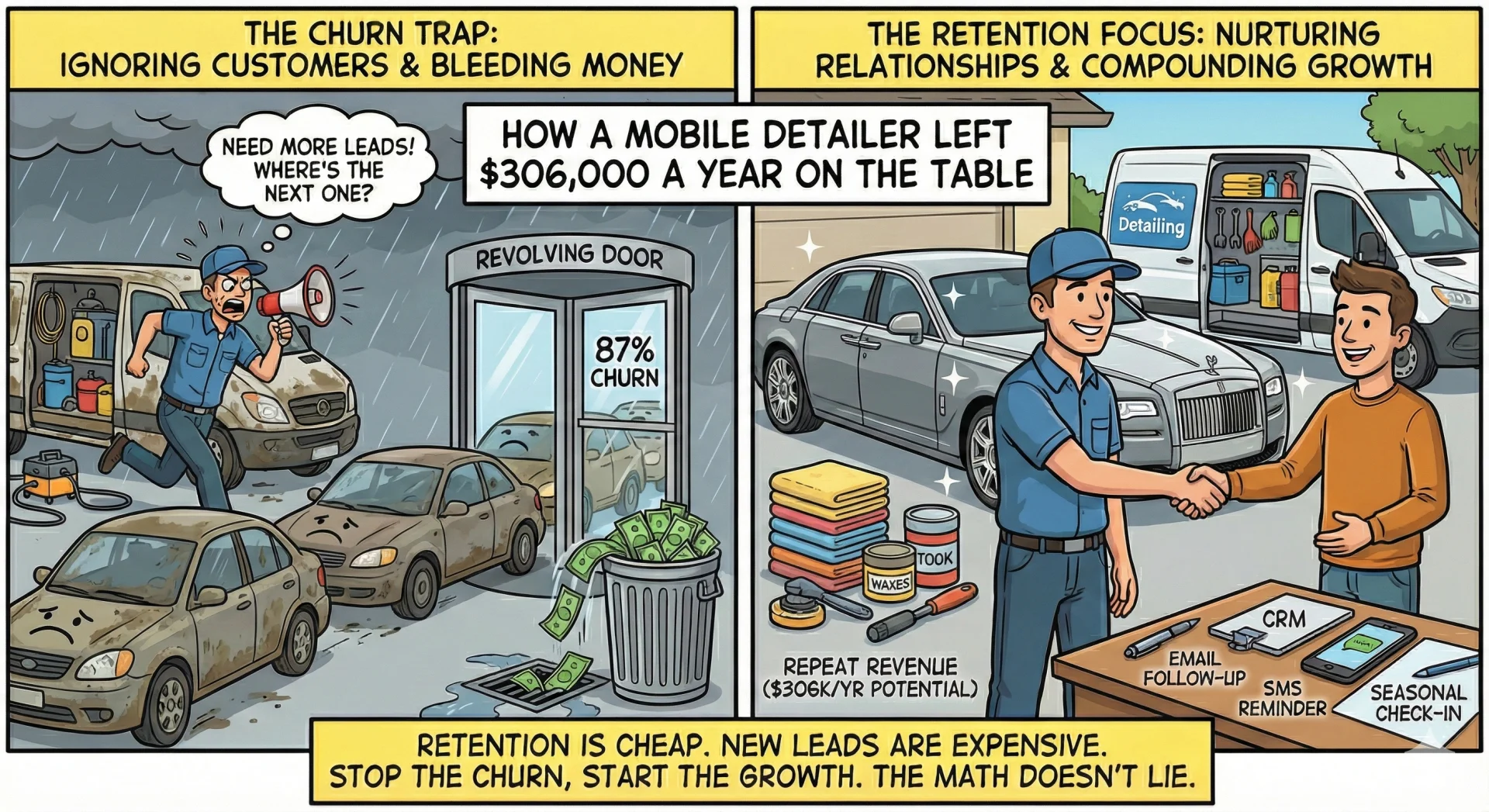
This is a real example from a real service business. Over the past few years, this mobile detailing company serviced 406 customers. Out of those 406 customers, only 77 ever came back. Three hundred and twenty-nine customers disappeared completely.
That’s an 87 percent churn rate.
Nobody inside the business treated that as a serious issue. They assumed the problem was lead flow. They did $45,000 in revenue that year and believed growth required more advertising. The numbers tell a very different story.
The average ticket for this business was $377.01. If each of those 406 customers came back just once per year, the business would generate about $153,000 annually. That alone is more than triple what they were doing.
But here’s the number that really matters. Mobile detailing is not a once-in-a-lifetime service. Most customers reasonably need it twice per year. At two visits annually, those same 406 customers represent roughly $306,000 in revenue.
Same service. Same customers. Same business. No additional ad spend. No new marketing channels. No complicated funnels or growth hacks.
The only thing missing was what happened after the first sale.
This is where most business owners get uncomfortable, because retention isn’t exciting. It doesn’t feel like growth. There’s no dopamine hit. No flashy dashboard. No new campaign to brag about. It’s just consistency, follow-up, and caring enough to stay present.
Instead, most businesses treat customers like a one-night stand. Get the job done. Get paid. Move on. No check-in. No reminder. No follow-up. Then they wonder why customers never come back.
Customers don’t leave because the work was bad. They leave because the business disappears. Life happens. People forget. Someone else shows up first the next time they need the service.
Retention doesn’t require genius. It requires effort after the transaction. A reminder. A follow-up text. A seasonal check-in. A simple "how did everything hold up" months later.
Today, there are hundreds of ways to do this. Email. Text. CRM reminders. Social media. Automated follow-ups. Manual follow-ups. There is no excuse not to stay in touch. The tools are cheap. The effort is minimal. The payoff is massive.
Instead of focusing on keeping customers, most businesses chase new leads like a desperate ex, throwing money at ads while ignoring the people who already trusted them once. New leads are expensive. Retention is cheap. New leads require persuasion. Retention requires remembering someone exists.
If this business had focused on bringing those customers back twice per year, the revenue conversation wouldn’t even be about survival. It would be about capacity, scheduling, and scaling.
Most small businesses don’t need better ads. They need to stop letting every customer walk out the door like the relationship is over.
Retention isn’t sexy. It’s not flashy. But it works. And the math doesn’t lie.