Business Fundamentals
Growth That Feels Hard Is Usually Misaligned
Author: Trevor Hunter
Published: September 6, 2025
Growth is supposed to feel challenging. It is not supposed to feel exhausting. There is a difference between effort that comes from expansion and exhaustion that comes from misalignment, and most business owners don’t recognize the difference until they are already burned out.
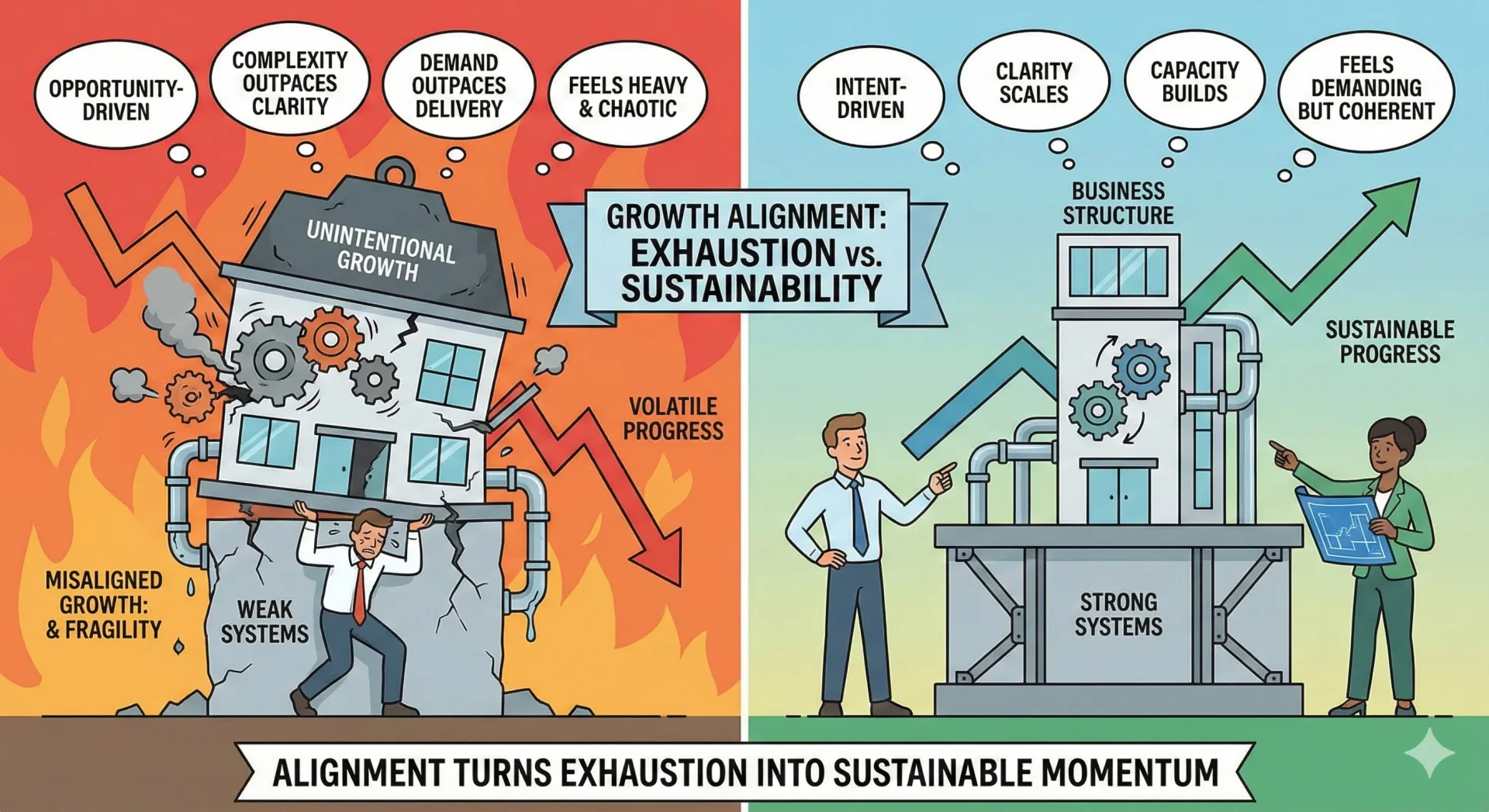
When growth consistently feels heavy, something is usually off. That does not mean the business is failing. More often, it means the business is growing in a direction it was never built to support. Revenue might be increasing, but everything else feels harder instead of easier.
Healthy growth creates pressure, but it also creates momentum. You feel stretched, but you can tell the work is moving the business forward. Misaligned growth feels different. It feels like every new customer creates more problems than progress. The schedule gets tighter. Mistakes increase. Stress rises. The payoff never feels proportional to the effort.
One of the most common causes of misalignment is saying yes to the wrong work. Businesses take on customers that do not fit their model, projects that stretch them too thin, or services they are not structured to deliver consistently. Revenue goes up, but margins shrink. Quality slips. The owner stays busy but never feels ahead.
Another major source of misalignment is growing demand without growing structure. More calls come in, more jobs get booked, but nothing about how the business operates changes. Scheduling stays messy. Communication breaks down. The owner becomes the bottleneck for every decision. What looks like growth on paper feels like chaos in real life.
This is where many owners start blaming themselves. They assume they are bad at business or bad at handling pressure. In reality, they are running a system past its capacity. No system performs well when it is overloaded, no matter how hard the person running it works.
Misalignment also shows up when growth outpaces clarity. If the business does not have a clear understanding of who it serves, what it offers, and how it delivers that service, growth magnifies confusion instead of fixing it. Every new customer adds another variable. Every new job introduces another way for things to go wrong.
A lot of businesses chase growth because they believe it will solve their problems. More money will reduce stress. More customers will smooth things out. More visibility will make everything easier. When growth is misaligned, it does the opposite. It amplifies every weakness the business already has.
Aligned growth feels different. It is still work, but the effort makes sense. Systems improve alongside demand. Decisions become clearer instead of harder. The business gets more stable as it gets bigger, not more fragile.
A simple test is to ask whether growth makes the business feel stronger or more brittle. If every increase in revenue comes with a spike in stress, something is wrong. Stability should increase with scale, not decrease.
Another signal of misalignment is constant compromise. Quality drops. Promises get stretched. The business starts doing things it said it never would just to keep up. That is not growth. That is erosion.
Real growth is selective. It involves saying no more often, not less. It requires tightening the definition of a good customer and improving systems before increasing volume. It is slower at first and dramatically easier later.
Growth that feels hard is not a badge of honor. It is a signal. The job is not to push harder. The job is to identify what is misaligned and fix it.
When growth is aligned, it still takes effort. It just does not feel like a constant fight. And that difference is what separates businesses that scale from businesses that burn out.