Business Fundamentals
You Don't Need More Tools — You Need Fewer Decisions
Author: Trevor Hunter
Published: August 22, 2025
When a business feels messy, the instinct is almost always the same.
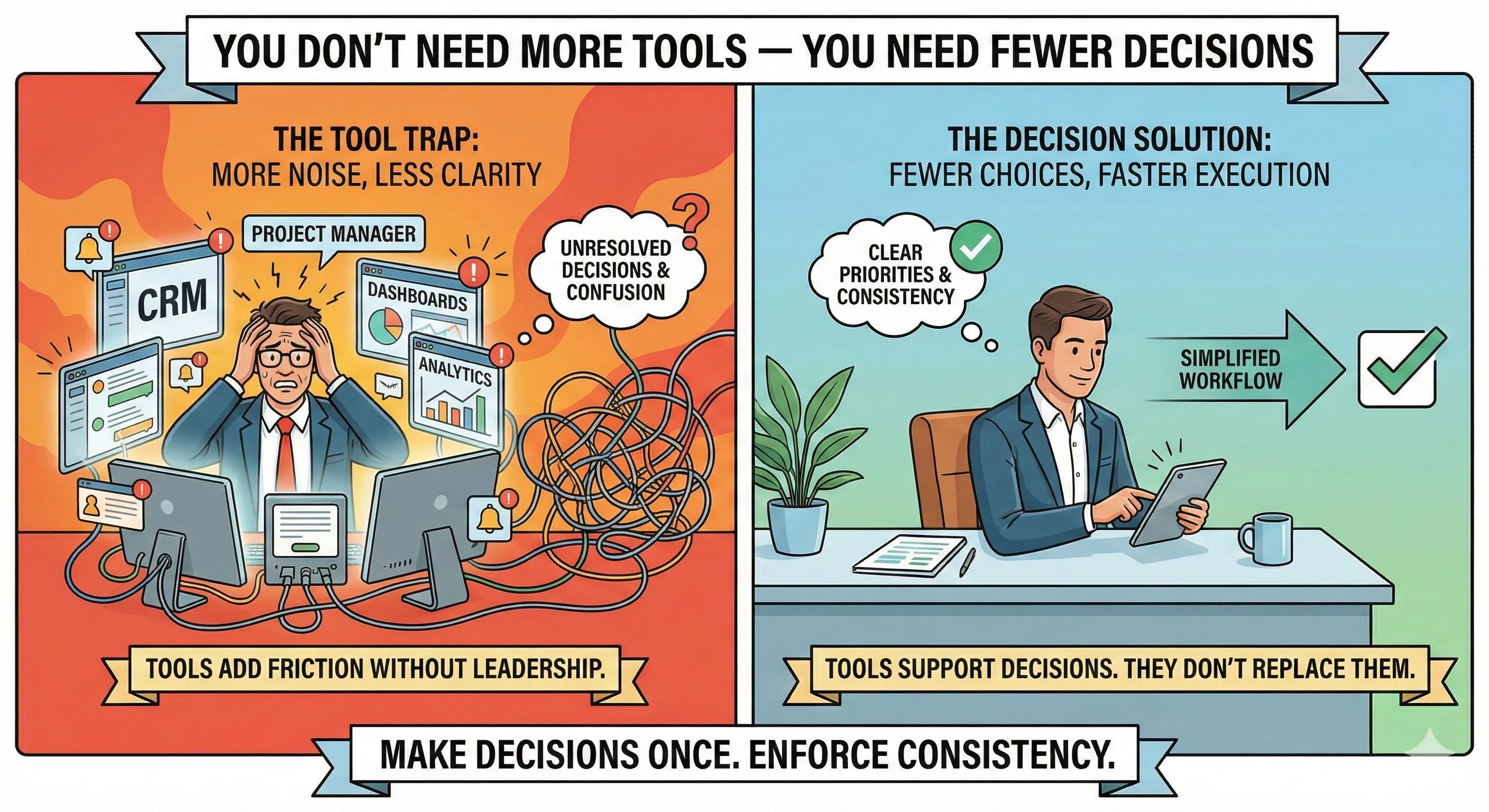
Get a new tool.
A better CRM. A new project manager. Another dashboard. Something that promises clarity, automation, or control.
For a moment, it feels like progress.
Then the noise comes back.
Most businesses don't have a tooling problem. They have a decision problem.
Tools don't create clarity. They just make decisions visible.
If you don't know what matters, no tool will tell you.
Early-stage businesses can get away with improvisation. Decisions are made quickly. Information lives in people's heads. The cost of mistakes is relatively low.
As things grow, that approach starts to crack.
Owners respond by layering on software to compensate for uncertainty. Each new tool promises to organize the chaos. In reality, it often just adds another place for confusion to live.
Now there are more notifications. More fields to fill out. More systems that need attention.
The business doesn't feel simpler.
It feels heavier.
The issue isn't that the tools are bad. It's that they're being asked to solve problems they weren't designed for.
A project management tool can't decide priorities.
A CRM can't define a good customer.
An analytics platform can't tell you what success looks like.
Those are leadership decisions.
Without them, tools just surface disagreement.
This is why teams argue about how to use software instead of what the work actually is. One person tracks one way. Another tracks differently. Everyone is technically "using the tool," but nothing feels aligned.
The root problem is unresolved decisions.
What actually matters this week?
Who owns what?
What does done mean?
If those answers aren't clear, the tool becomes a battlefield.