Business Fundamentals
If Everything Is a Priority, Nothing Is
Author: Trevor Hunter
Published: August 14, 2025
Most businesses don't suffer from a lack of priorities.
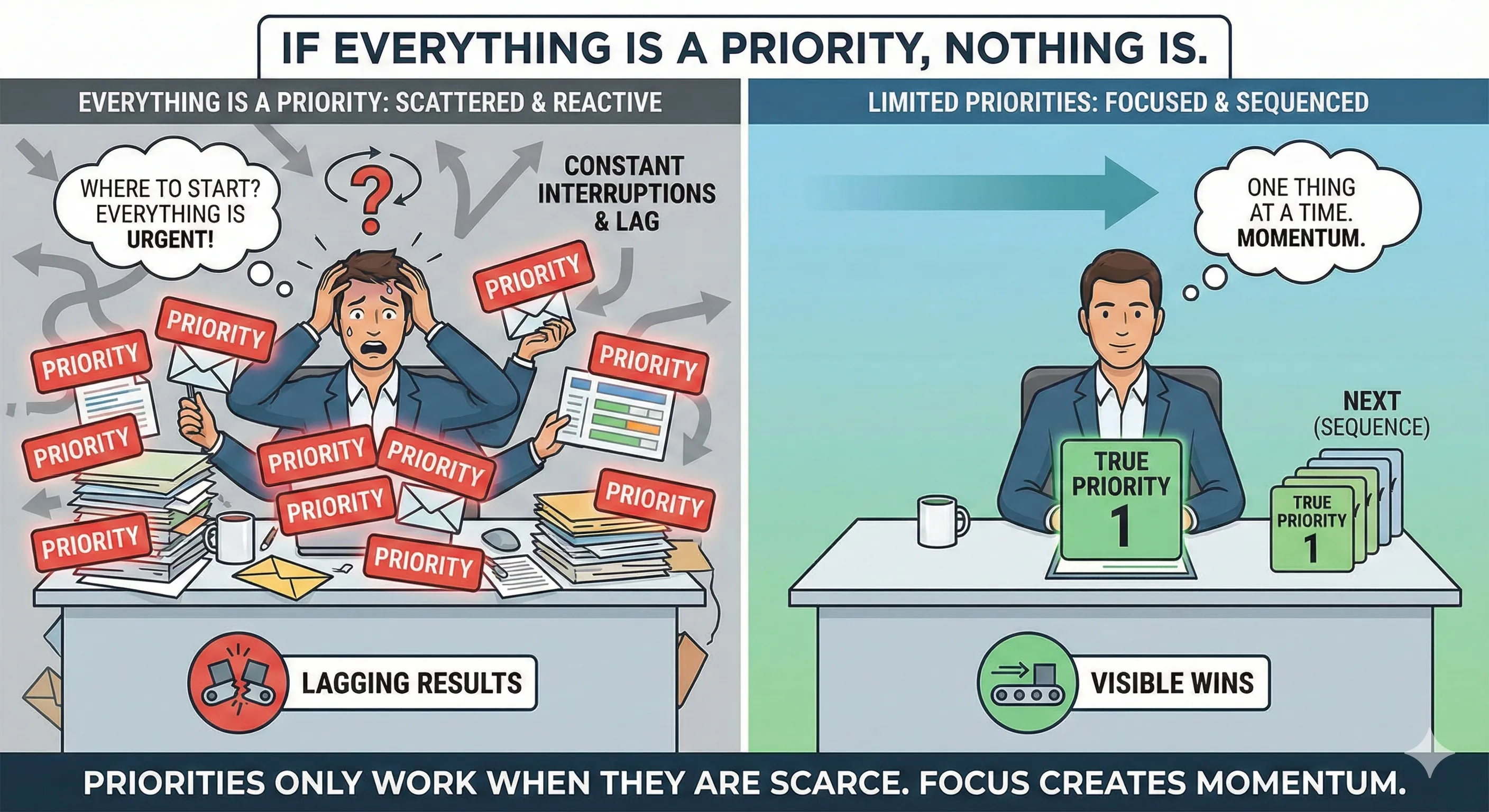
They suffer from too many.
Everything feels important. Every request feels urgent. Every problem feels like it needs immediate attention.
So nothing gets the focus it deserves.
When everything is a priority, the business operates in permanent reaction mode. Decisions get made based on who's loudest, who's waiting, or what feels most uncomfortable in the moment.
That's not strategy.
That's triage.
Early on, this can work. Small teams move fast. Owners can juggle multiple priorities because the scale is manageable.
As the business grows, the same behavior becomes destructive.
Context switching increases. Work gets interrupted. Progress stalls because nothing is allowed to run uninterrupted long enough to finish properly.
People stay busy.
Results lag.
This is where owners mistake motion for leadership.
They're involved everywhere. They're responsive. They're solving problems all day.
But the business isn't getting better.
True prioritization requires saying no to reasonable things. That's why most businesses avoid it.
It feels irresponsible.
If a customer needs something, shouldn't it be a priority?
If a team member is blocked, shouldn't it be addressed?
If an opportunity appears, shouldn't it be explored?
Individually, yes.
Collectively, no.
Priorities only work when they're scarce.
A real priority has weight. It displaces other work. It changes behavior. It dictates how time and energy are allocated.
If nothing gets displaced, nothing was actually prioritized.