Business Fundamentals
The Real Cost of Cheap Customers
Author: Trevor Hunter
Published: May 3, 2025
Cheap customers don't usually look like a problem at first.
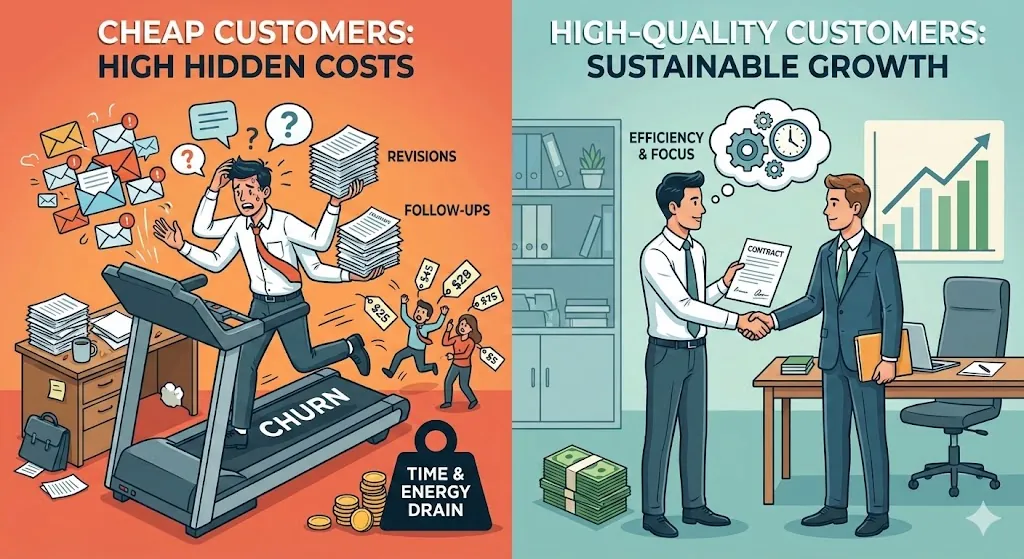
They show up quickly. They say yes easily. They're grateful you're affordable. In the early days, they feel like momentum.
That's why so many businesses build themselves around them.
The issue isn't that these customers are bad people. It's that they come with costs that don't show up on the invoice.
And those costs compound.
Cheap customers take more time. They ask more questions. They second-guess decisions. They want reassurance at every step. They need explanations that higher-paying customers don't.
That extra time rarely gets accounted for.
On paper, the job looks profitable. In reality, the margin disappears into emails, calls, revisions, and follow-ups.
Cheap customers are also more sensitive to friction. Small delays feel bigger. Minor issues feel personal. Normal boundaries feel restrictive.
That puts constant pressure on delivery.
Teams spend more energy managing expectations than doing the actual work. Owners step in more often to smooth things over. Everything feels heavier than it should.
Another hidden cost is volatility.
Cheap customers leave faster. They shop around more. They're less loyal because they're buying based on price, not fit. When something slightly cheaper appears, they're gone.
That creates churn.
Churn forces you to constantly replace customers just to stay even. That replacement effort drains time and attention that could have gone into improving the business.
It's a treadmill.
Cheap customers also distort decision-making.
When most of your revenue comes from low-margin work, every decision feels urgent. You can't afford mistakes. You can't afford downtime. You can't afford to be selective.
So you keep saying yes.
You add services you shouldn't. You stretch the team. You accept work that doesn't fit. The business slowly loses its shape.
This is where burnout starts.
Owners blame themselves for being tired, but the real issue is that the business is optimized for stress instead of sustainability.